Voyager 1 Is Nearly One Light-Day From Earth. Soon a Reply Will Take Two Days.
NASA expects Voyager 1 to reach 24 hours of one-way light travel time on November 18, a future milestone that exposes the true scale of deep-space communication.
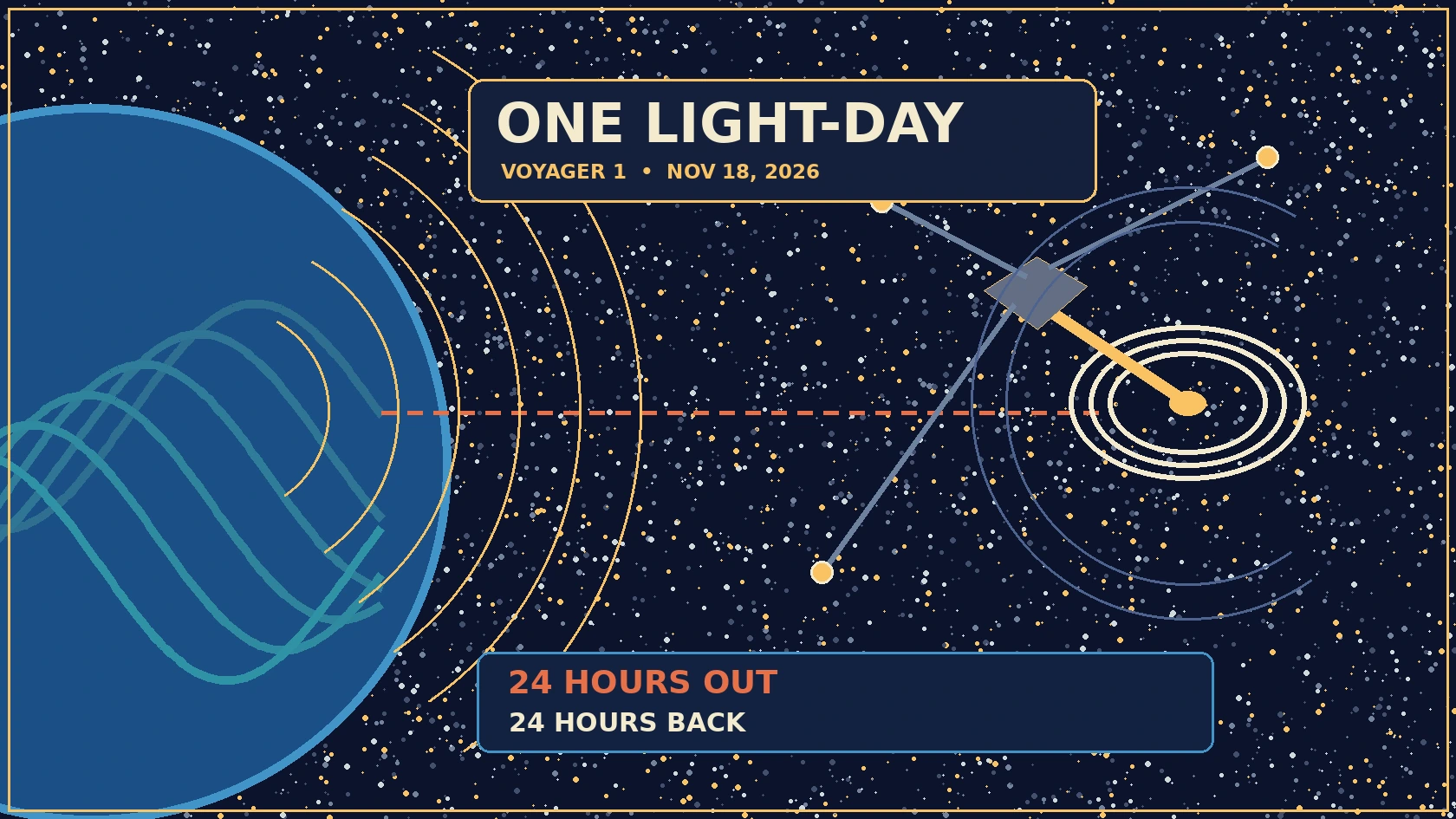
On 18 November 2026, NASA expects Voyager 1 to cross a distance from Earth so large that light—or a radio command—takes an entire day to travel it. The milestone is one light-day, roughly 16.094 billion miles or 25.902 billion kilometers. It is still in the future as of 4 November; the spacecraft has not yet passed the marker. No mechanical event happens at the crossing, but the distance makes the mission’s communications challenge remarkably concrete.
NASA's one-light-day explainer places the predicted crossing at 5:16:07 a.m. Eastern Standard Time on Wednesday, 18 November 2026—10:16:07 UTC. This is a projected orbital-navigation milestone, not an observation of an event that has already happened.
A light-day measures distance, not a very slow day
A light-day is the distance light travels through space in 24 hours. Because radio waves propagate at light speed, a command sent from Earth to Voyager at that distance would take about 24 hours to reach the spacecraft. Even an immediate acknowledgment would take roughly another 24 hours to arrive at Earth. Engineers therefore cannot steer the probe as if controlling a nearby robot or a drone in real time.
A typical conversation depends on fractions of seconds of feedback. At Voyager’s distance, the fastest theoretical round trip becomes two days. Operations rely on carefully planned command sequences, autonomous onboard systems and the Deep Space Network’s large antennas rather than interactive corrections. The 24-hour label also refers to the Earth-probe geometry and changes as both objects move; it is not a fixed permanent communication delay.
NASA's live Voyager mission-status page gives the equivalent Pacific Standard Time as 2:16:07 a.m. and identifies Voyager 1 as the first human-made object on course to reach the distance.
What the probe has accomplished since 1977
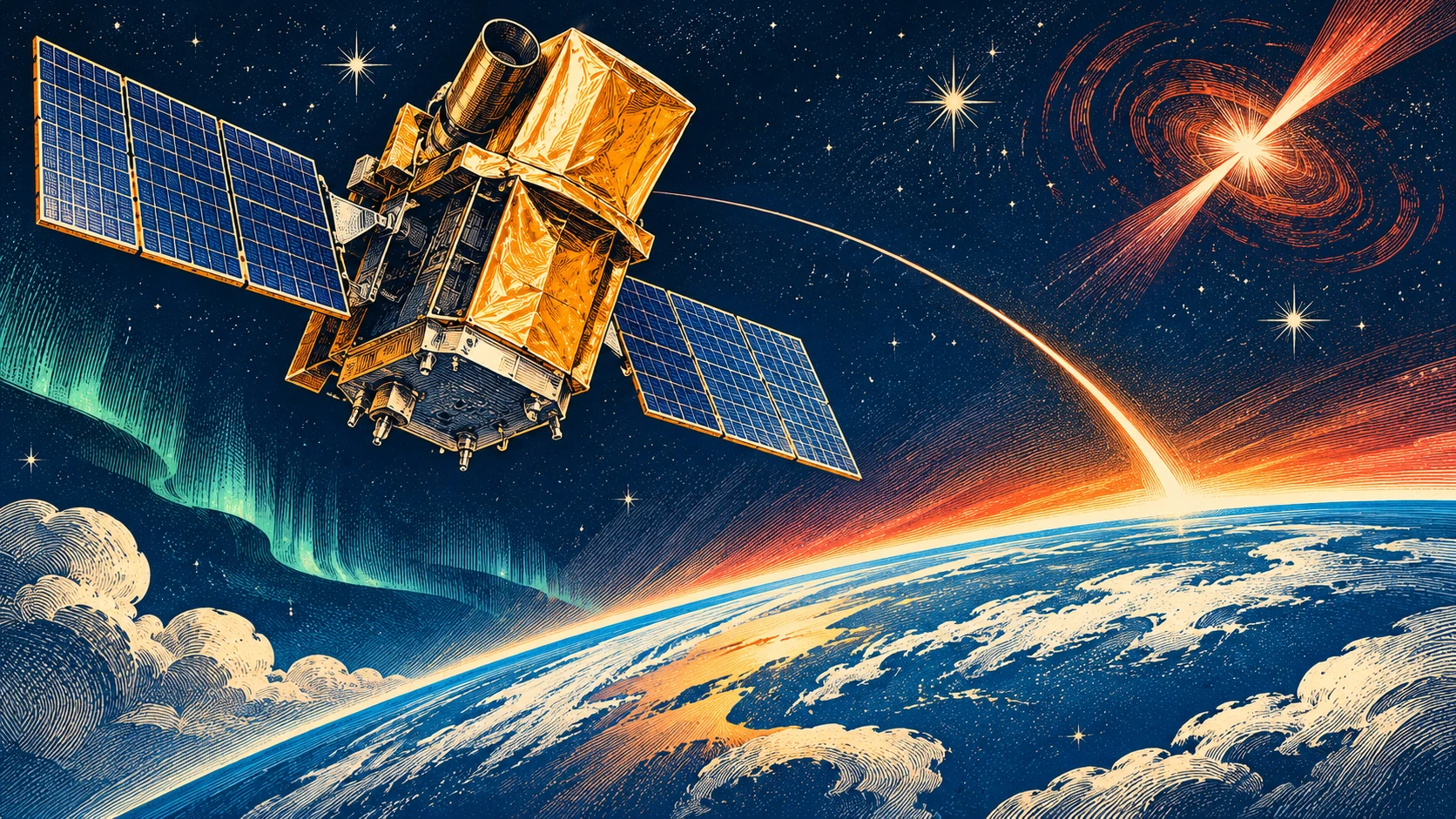
Voyager 1 launched on 5 September 1977 and flew past Jupiter and Saturn before continuing outward. It crossed the heliopause in August 2012, entering interstellar space beyond the main influence of the Sun’s solar wind. The spacecraft is still traveling and returning limited scientific information decades after its original planetary encounters.
NASA expects its twin Voyager 2, which followed a different trajectory past Uranus and Neptune, to reach the one-light-day distance around November 2035. Both probes remain uniquely valuable for measurements beyond the heliosphere, but Voyager 1 is much farther along its outward path.
An engineering achievement under shrinking power
The probes use radioisotope thermoelectric generators that produce diminishing electrical power as radioactive material decays and components age. Engineers have progressively turned off instruments and managed power budgets so that essential communication and selected scientific measurements can continue. The one-light-day crossing does not improve the spacecraft’s health or provide a new instrument capability.
In an October 2026 JPL mission update NASA described recent power conservation and a resolved communications interruption, illustrating the ongoing work needed to maintain contact with such a distant spacecraft.
An October-to-November claim that Voyager is 'one day away' can easily be misunderstood. The 24 hours describes the signal's one-way travel time once the distance marker is reached, not how much calendar time remains until the crossing. Likewise, one light-day is not one light-year. A light-year covers roughly 365 times more distance.
What readers can actually watch
NASA provides a mission page with a continually updated position display. The published crossing time is a projection derived from the spacecraft’s trajectory and Earth’s movement, and precise values may be updated with new navigation solutions. Readers should consult the live NASA page for the latest status near 18 November and avoid reposts that announce the milestone early.
The number matters because it expresses a human-scale limit. Earth and Voyager still exchange instructions and data across a gap that consumes a day of light travel in each direction. The milestone will not trigger a flash, alter the spacecraft’s route or start a new mission phase. It marks the persistence of a machine launched nearly half a century ago—and the discipline required to keep communicating with it.
Publication history
— First published.
No published corrections or earlier versions.
How this was made
UpThat uses AI-assisted research and writing. Source checking and publication follow our editorial review workflow. See the original documents above to assess the reporting.
How we use AI ↗