NASA’s Swift Telescope Is Returning to Earth After 22 Years. Where Might It Land?
NASA expects the long-running gamma-ray observatory to re-enter the atmosphere on 4 November, but debris locations and timing remain uncertain.
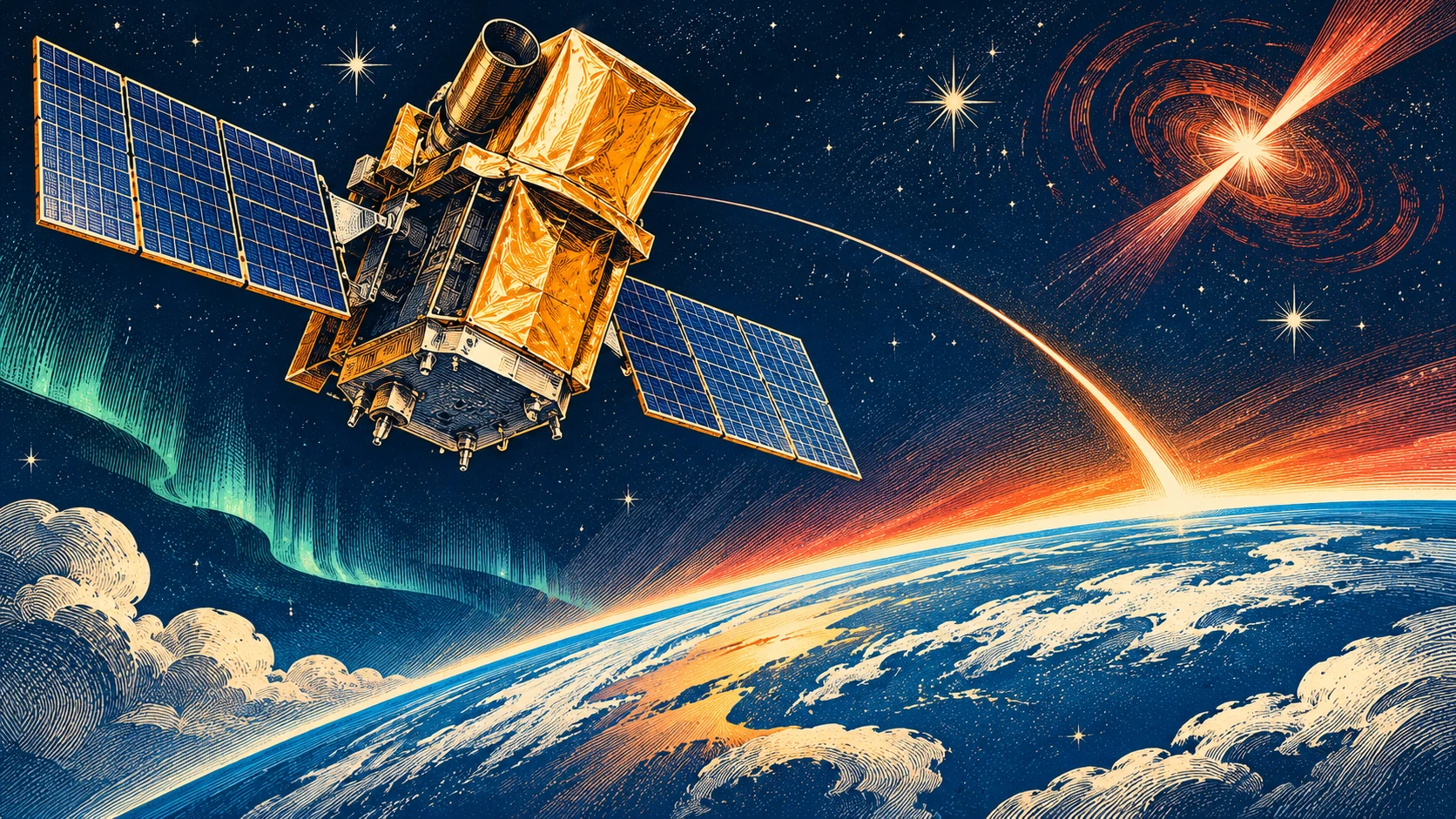 Editorial visualization
A spacecraft built to detect the most violent explosions in the universe is nearing its own fiery end. NASA expects the Neil Gehrels Swift Observatory, launched in 2004, to fall back into Earth’s atmosphere on 4 November 2026 after nearly 22 years in orbit. The spacecraft has already stopped science operations. The exact re-entry moment and the locations of any surviving debris remain uncertain.
NASA’s 2 November re-entry notice cited a US Space Force forecast of 3:30 a.m. Eastern on 4 November, with an 11-hour uncertainty window. That is a forecast, not confirmation that re-entry has already occurred.
Why a long-lived observatory is falling
Swift was designed for a two-year prime mission but lasted more than ten times that long. It made a specialty of gamma-ray bursts, intense flashes linked to catastrophic cosmic events. Three instruments observed different wavelengths, while the spacecraft could slew rapidly to turn toward a newly detected burst and alert observatories on the ground and in space to look while the event was still unfolding.
Low Earth orbit is not frictionless. Even hundreds of kilometers above the surface, a thin atmosphere pulls on a satellite. Solar activity heats and expands that atmosphere, increasing drag. Swift had no propulsion system capable of lifting itself back to a safer altitude. The satellite’s orbit therefore decayed, and the combination of limited altitude and increasing drag made precise pointing progressively harder.
In its 23 October mission-end update, NASA said Swift reached about 275 kilometers altitude on 20 October, entered safe mode and was commanded to end operations in preparation for re-entry. Its telescopes were no longer able to hold the steady pointing needed for science.
What can actually survive the fall?
NASA estimates Swift weighed about 3,200 pounds, or roughly 1,450 kilograms. The agency expects most of the spacecraft to burn up as it plunges through the atmosphere, but says some parts may survive. Dense or heat-resistant components can outlast the thin structures that disintegrate earlier. That does not mean an intact telescope will land somewhere: re-entry breaks spacecraft apart under forces and temperatures far beyond ordinary service conditions.
Swift’s orbit limits possible ground tracks of surviving pieces to a band between approximately 20.6 degrees north and 20.6 degrees south latitude. This includes extensive ocean areas and portions of several continents. The narrower a forecast becomes, the easier it is to estimate a possible footprint; until then, naming a particular town, nation or ocean as the landing place would be speculation.
NASA gives a roughly one-in-2,100 probability of harm to any person. This is a modeled global casualty risk, not the odds that a specific individual will be struck, and not a prediction that harm will occur. The figure warrants transparent reporting rather than either panic or a guarantee that the risk is zero.
Why the forecast keeps moving
A predicted re-entry time depends on the spacecraft’s changing orbit, orientation, atmospheric density and space weather. Small changes in those inputs can shift the final orbit enough to move a possible debris corridor over large distances. Forecasts also get more precise as tracking data accumulate. A date given early in the week should not be mistaken for a fixed appointment.
Reuters reported on the approaching return and the failed commercial servicing attempt. At the time of this article’s preparation, an official public confirmation of re-entry had not been verified.
The attempted rescue that did not happen
A NASA-backed commercial project tried to extend Swift’s mission by sending another spacecraft to grapple it and raise its orbit. Katalyst Space’s LINK vehicle launched in July, but suffered attitude-control difficulties and did not capture Swift. The boost effort was called off in August. The attempt was unusual because it tested whether a satellite originally built without an ordinary refueling or docking interface could be rescued in orbit.
That failure does not erase the technology lessons. Spacecraft servicing will matter as governments and operators try to extend the useful lives of expensive satellites, clear hazards and reduce replacement costs. But Swift illustrates how difficult a real rescue is under time pressure, with a rapidly descending target and a servicing vehicle that itself must remain controllable.
The science that remains
Swift’s observations survive the satellite. Its rapid alerts helped researchers chase transient cosmic events before they faded, contributing to the study of gamma-ray bursts, supernovae, black holes and other changing sources. Its career also shows how a modest two-year design target can produce decades of scientific value when a mission team can adapt instruments and operations over time.
NASA and the Space Force are expected to refine the re-entry estimate with continued tracking. What will happen to each fragment is not yet settled; what has already happened is clear: a spacecraft built to follow brief flashes across the universe helped astronomers watch a changing sky for more than twenty years.
Publication history
— First published.
No published corrections or earlier versions.
How this was made
UpThat uses AI-assisted research and writing. Source checking and publication follow our editorial review workflow. See the original documents above to assess the reporting.
How we use AI ↗