CERN Finds Evidence of a One-in-Ten-Billion Decay. It Is Not Yet a Discovery.
LHCb has reached 3.2-sigma evidence for a neutral B meson decaying into two muons, using upgraded detector data and older runs. The result agrees with the Standard Model—and shows how precision can probe physics beyond it.
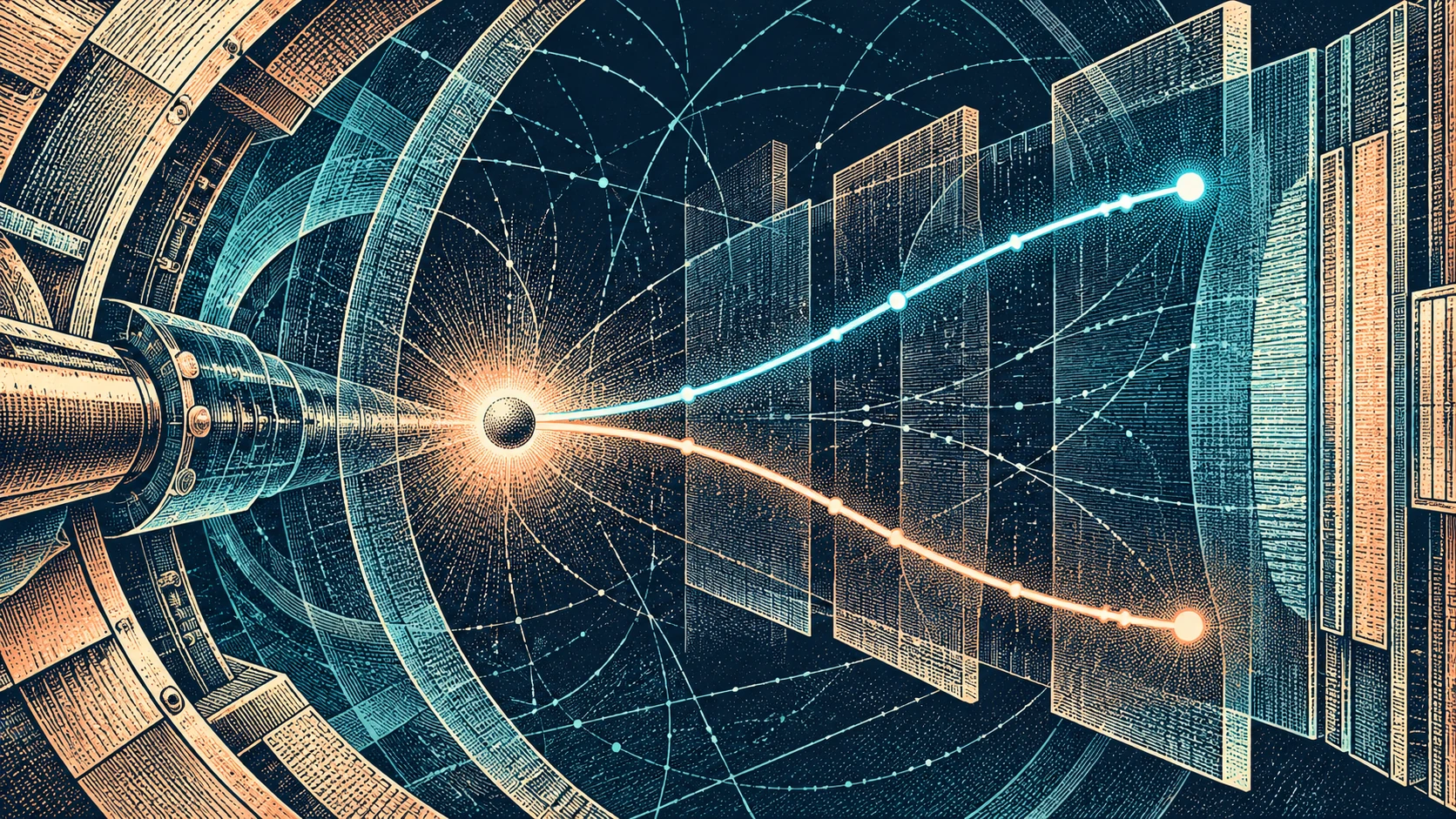 Editorial visualization
CERN’s LHCb experiment has found the strongest single-experiment evidence yet for a particle decay so uncommon that the Standard Model expects it to occur only about once in every ten billion cases. Announced on 3 November 2026, the result concerns a neutral B meson turning into two muons. It took decades of searching, a major detector upgrade and new analysis of collisions. But the distinction matters: at 3.2 standard deviations, physicists have evidence, not the five-sigma observation needed to declare a discovery.
The CERN announcement reports 3.0 sigma in the upgraded detector’s 2024–25 sample and 3.2 sigma after older LHCb data were included. The result agrees with current theoretical expectations.
The decay hidden in a mountain of collisions
The particle is known as B0, or Bd: a short-lived meson containing a beauty quark and a down antiquark. Researchers are looking for its decay into a positively charged and a negatively charged muon. Muons resemble electrons but are much heavier. A B meson does not normally choose this exit route; far more common decays create other particles. The rarity makes the two-muon final state useful as a precise test of fundamental physics.
In the Standard Model, this transformation is strongly suppressed. Its rate can be influenced by quantum processes involving particles that are not themselves seen emerging from the collision. That makes the decay an indirect probe of possible physics beyond the Standard Model: new heavy particles might shift the measured probability even if the collider cannot manufacture those particles directly. A careful measurement is therefore meaningful whether it agrees with theory or departs from it.
The LHCb collaboration’s technical explanation notes that the B0 two-muon decay is expected to be about 30 times rarer than the corresponding Bs decay, while B0 mesons are produced more often. Both signal and background must be modeled.
Evidence is not the same as discovery
LHCb reports a signal significance of 3.0 sigma using Run 3 data alone, rising to 3.2 sigma when the experiment’s earlier runs are combined. Particle physicists commonly treat roughly three sigma as evidence worth serious attention. A claim of observation generally requires five sigma, a much stricter threshold designed to limit false discoveries in analyses that search through enormous numbers of particle interactions.
A sigma value measures how strongly the data disfavor a specified background-only explanation under the analysis assumptions. It is not the probability that the Standard Model is correct, and it does not prove that a new particle has been found. Nor should the phrase 'one in ten billion' be read as one success in every ten billion collisions at the LHC: it refers to the tiny branching fraction of this particular kind of B meson, not the overall collision rate.