Stanford Is Building a Digital Brain. It Is Not a Simulated Person.
A five-year project will combine 7-Tesla MRI, wearable MEG and AI to predict brain dynamics—not recreate consciousness or deliver a finished clinical treatment.
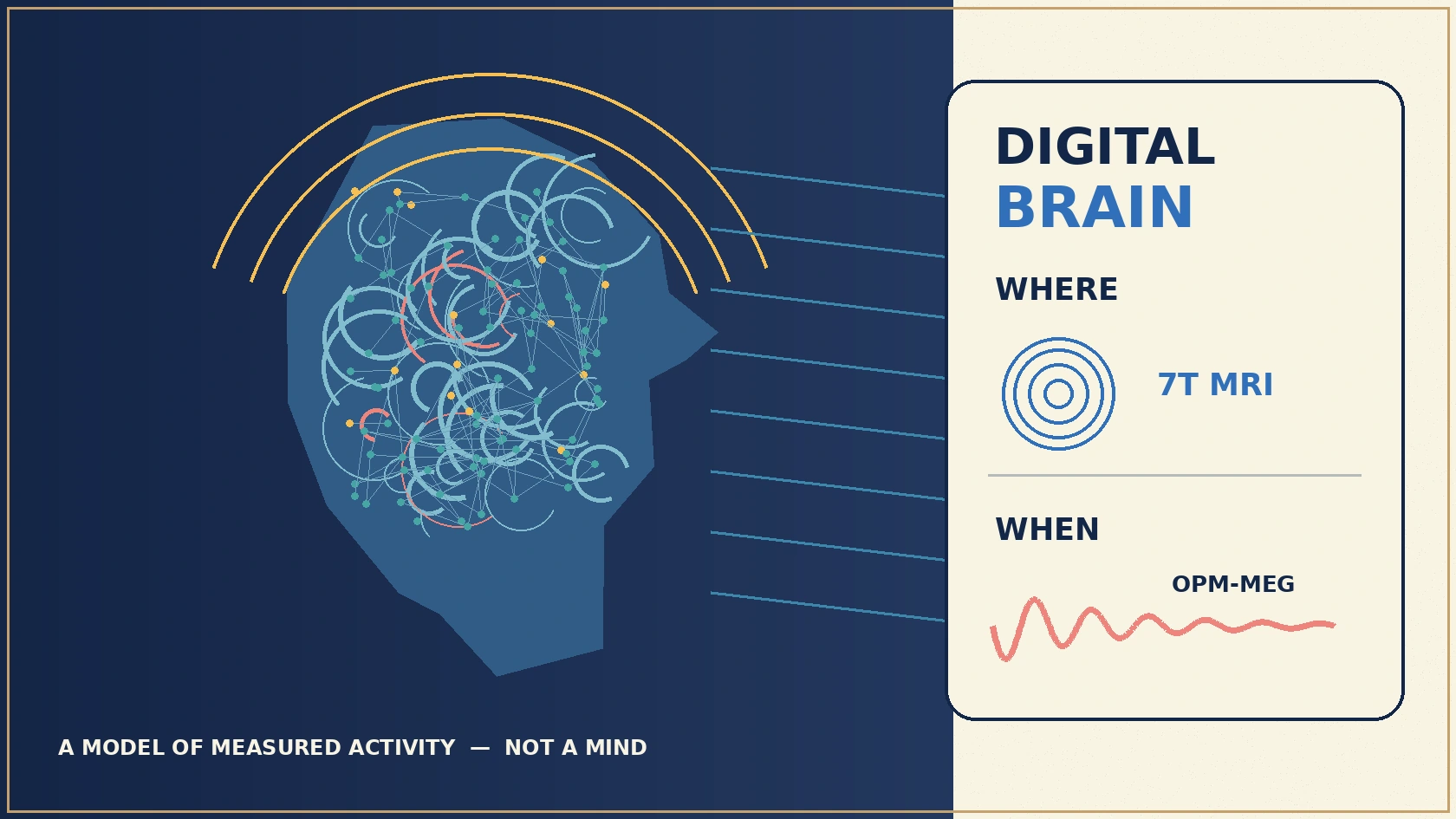
Stanford has launched a five-year effort to build predictive computer models of the human brain, using unusually detailed recordings of how people perceive, remember and respond to the world. Announced on 2 November 2026, the Stanford Digital Brain Project is an ambitious research program—not a finished simulation of a person’s mind, a way to read private thoughts or an established treatment for neurological disease.
The Stanford Digital Brain Project announcement describes a collaboration among neuroscientists, computer scientists and clinicians supported by gifts from Mark and Mary Stevens and Clara Wu Tsai.
The problem is measuring a brain across space and time
A brain scanner does not provide direct access to every neuron firing. Standard functional MRI uses changes in blood oxygenation as an indirect signal; it is informative about where networks are active but has limited temporal precision. Magnetoencephalography, by measuring the tiny magnetic fields associated with neural activity, gives finer timing but poses its own spatial-localization challenges.
Stanford plans to pair a high-field 7-Tesla MRI system with wearable optically pumped magnetometer magnetoencephalography, or OPM-MEG. The former provides high spatial resolution, while the latter can track changes on a millisecond timescale. By analyzing both measurements alongside what participants actually saw, heard, remembered or described, researchers hope to train models that make testable predictions rather than only visualizing brain scans.
The project's research overview outlines ten experimental campaigns, starting with people watching and describing audiovisual scenes while their brain activity is recorded with complementary instruments.
What a digital brain model would predict
Imagine a model that receives a description of a visual scene and predicts how a person’s attention-related brain networks should respond. Scientists could compare that prediction with a fresh experiment. A model that works only on the recordings used to train it would not be enough; it must be tested on new participants, circumstances and independent datasets.
The project says it will begin with systems related to perception, memory and attention before attempting broader models. The research is structured as an iterative cycle: design experiments, collect brain and behavior measurements, train models, test their predictions and use failures to improve the next experiment.
The planned data infrastructure includes Stanford’s Marlowe GPU computing cluster and established open-science tools such as OpenNeuro and the Brain Imaging Data Structure. The consortium intends to make models and datasets available for researchers to evaluate and reuse, subject to the practical handling of sensitive human-participant data.
Why the 'digital twin of a brain' analogy has limits
A computer model that predicts certain brain responses is not a complete simulation of an individual’s neurons, life history or consciousness. It also cannot be assumed to reproduce free will, memories or a person’s private thoughts. The project’s strongest immediate claim is about developing a better research instrument: a predictive model can expose gaps in a theory by making predictions that real measurements could falsify.
The project has not yet shown that its future models will diagnose depression, predict Parkinson’s disease or recommend effective treatments. Researchers hope that comparing normal and disrupted brain-network patterns could eventually guide biomarkers or interventions. Each medical application would need separate validation against clinical outcomes and patient populations.
In Stanford’s explanatory podcast team leaders Dan Yamins and Russ Poldrack discuss the proposed experiment-to-model cycle and the distance between an ambitious predictive model and practical clinical tools.
The scientific challenge ahead
Brain signals are noisy, people vary considerably and MRI and MEG measure different aspects of activity rather than directly observing the same events. Combining their results requires careful alignment, repeated measurements, protection against false correlations and meaningful comparison with simpler modeling baselines. Data sharing will also need consent, privacy safeguards and information about how well a model generalizes beyond the participants who contributed data.
The five-year program is a bet that advances in sensing and machine learning can reinforce one another. If the first models predict previously unseen measurements well, they could make neuroscience experiments more targeted. If they fail, the failure could still help reveal which assumptions about perception, attention or memory need revision. Stanford is starting a long experimental campaign, not announcing that the human brain has been decoded.
Publication history
— First published.
No published corrections or earlier versions.
How this was made
UpThat uses AI-assisted research and writing. Source checking and publication follow our editorial review workflow. See the original documents above to assess the reporting.
How we use AI ↗