OpenAI Built Pando Because AI Coding Agents Overwhelmed Its Git Infrastructure.
Pando delivers nearly one petabyte of source-control data daily and cuts median push time, but the bigger story is how source-control architecture adapts to concurrent agents.
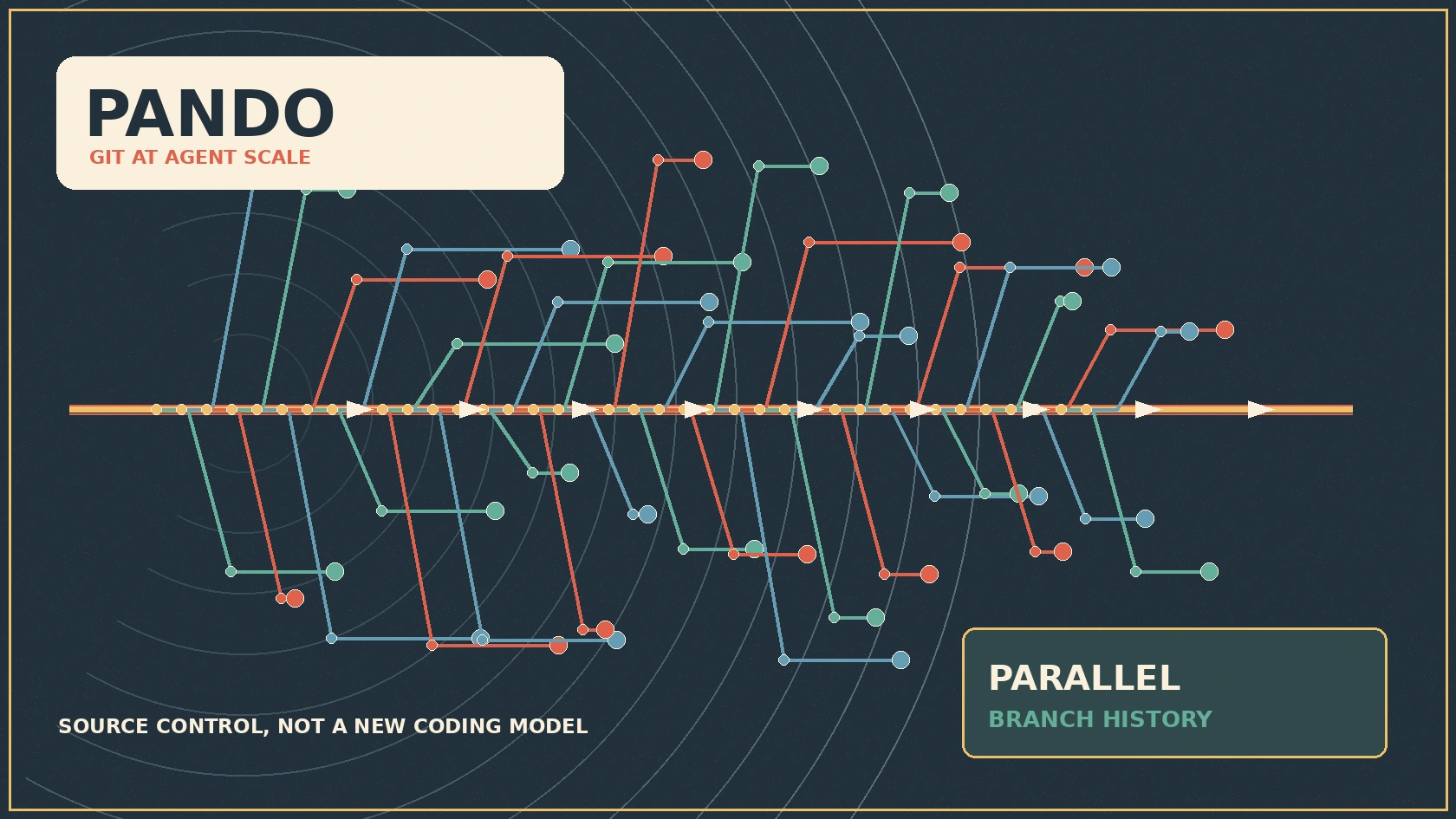
OpenAI has built a new Git-compatible source-control backend called Pando to cope with a codebase worked on by increasing numbers of software agents and human engineers. In an engineering report published on 2 November 2026, the company said Pando now serves its monorepo, reduces median push latency by nearly fivefold and delivers close to a petabyte of Git data per day. It is an internal infrastructure design, not a new public Git-hosting product.
The figures come from OpenAI's detailed Pando engineering post by Aaron Friel, Taylor Blau and Ted Nyman. The account explains the design, the operating trade-offs and the company's rollout.
AI coding agents changed the pressure on a familiar tool
Git was designed to track project history, and its protocol still underpins enormous software operations. But dozens or hundreds of agents generating branches, commits, CI jobs and downloads can stress servers in different ways from a small team of humans. One developer may ask several agents to work simultaneously; each change triggers more repository reads and updates. OpenAI says its legacy system was struggling to keep up.
The bottleneck was not simply storage size. A Git server must advertise relevant branch references, receive compressed object packs, decide whether a branch update is valid and serve history to clients at very high speed. When many independent updates compete through shared coordination, the total volume of parallel work can exceed the limits of the backend even if each individual push is modest.
Pando changes how the server coordinates branches
OpenAI chose not to require a consistent, simultaneous view of every branch in the repository. Pando serializes updates to each individual reference, but unrelated branches can progress independently. A reader fetching one branch sees the causally relevant history; a reader surveying multiple branches may observe states from slightly different points in time. That deliberate relaxation reduces coordination overhead, while preserving the behavior needed for common Git workflows.
On writes, Pando stores the incoming packfile as an immutable blob and records version and dependency metadata rather than maintaining a complete mutable local copy of the repository on every server. On reads, it selects reusable packs from storage and caching nodes to satisfy the history a client needs. This shifts much of the cost from recomputing per-client packfiles to serving already-produced bytes.
This builds on Git's standard packfile-URI capability, which allows a server to direct clients to additional packfile downloads over supported protocols. Pando uses that capability with large caches and a modified Git distribution, rather than requiring engineers to abandon the Git interface.
Nearly fivefold faster pushes do not mean fivefold faster programming
OpenAI reports its production median push latency fell by nearly 80% and that its regional pack caches reach more than 99% hit rates, helping serve high volumes with relatively little computation. These are internally reported infrastructure figures. They should not be converted into a claim that developers produce code five times faster, nor that any organization can reproduce them simply by installing a server.
The article describes a compaction scheme similar to log-structured merge trees: small incoming packs are grouped into larger covers that help plan future fetches efficiently. In effect, Pando maintains enough historical structure to make frequently requested objects cheap to find and transmit. That design trades storage and consistency choices for parallelism and predictable data delivery.
An AI-built backend with a human-designed architecture
OpenAI says Pando was developed with Codex over ten weeks. One engineer designed the core system, teams of agents helped implement it and a smaller engineering group deployed it. Validation included Git conformance tests, deterministic simulation and formal methods. These steps matter because concurrency bugs can corrupt or lose work despite code that looks correct during normal tests.
The company introduced Pando gradually as a proxy for the existing Git backend to preserve compatibility during rollout. It also published changes to its Git client and worked on upstream contributions. Not every enhancement is already included in stock Git: some features remain specific to OpenAI's build.
An outside technical review of OpenAI's patches distinguishes improvements already present in upstream Git from parallel-pack changes and explicit-haves behavior that still depend on OpenAI-specific implementations.
What this signals about the agent era
Faster AI code generation only helps when testing, code review, source control and deployment can absorb the output. The new scaling problem is not limited to models writing more lines; it involves distributing the same history to many isolated environments and coordinating many concurrent updates without losing correctness. Pando is one concrete response to that workload. Its underlying architecture may be informative for other large engineering teams, but OpenAI has not announced a generally available Pando service.
Publication history
— First published.
No published corrections or earlier versions.
How this was made
UpThat uses AI-assisted research and writing. Source checking and publication follow our editorial review workflow. See the original documents above to assess the reporting.
How we use AI ↗