MIT's AI Weight Edit Made Qwen Score Six Times Higher. It Mostly Fixed a Thinking Loop.
GPT-6 Astra changed a tiny share of a small Qwen model's weights and raised math scores—but the experiment points to a repair mechanism, not new mathematical knowledge.
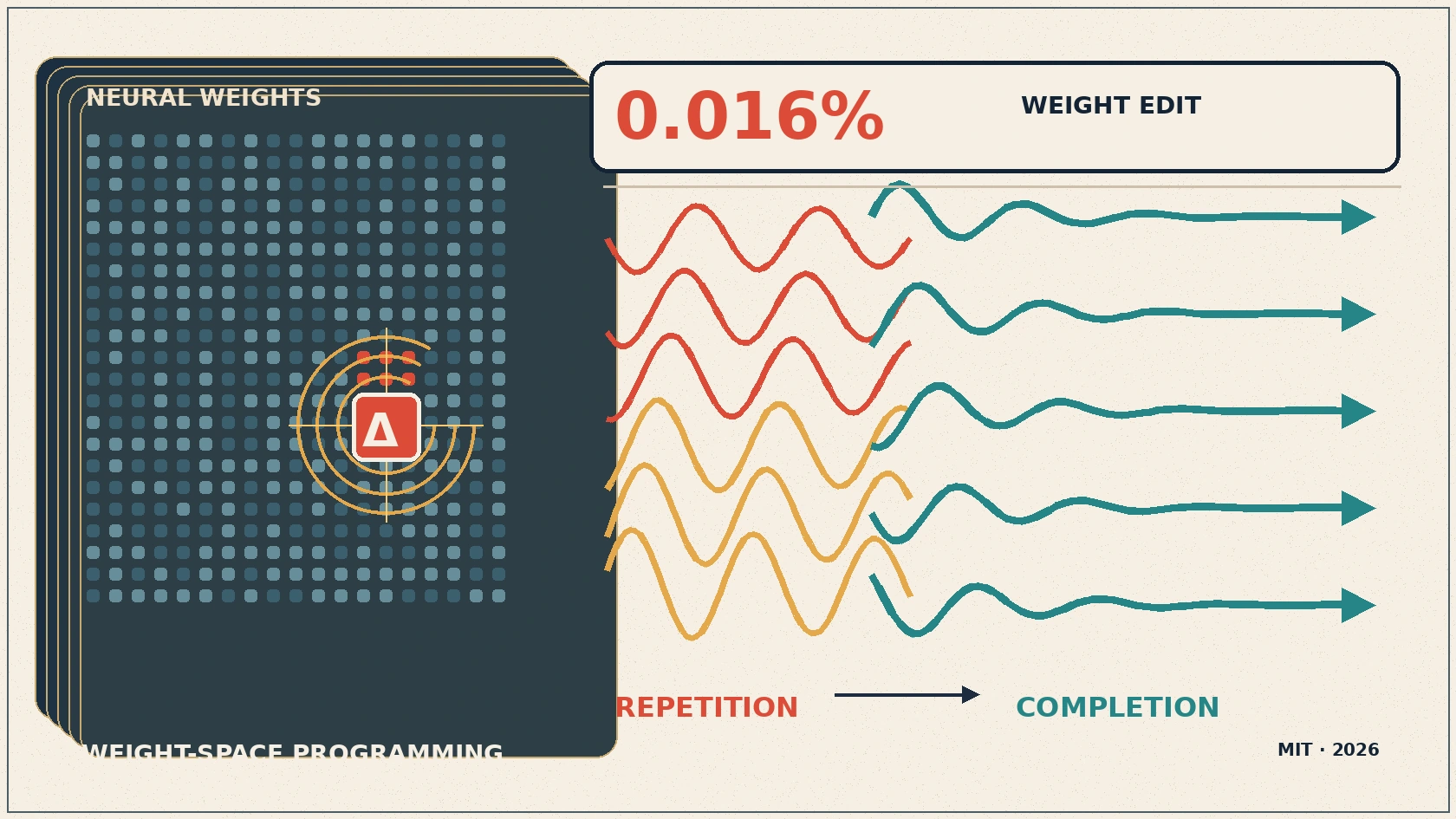
A small AI model’s math-test score jumped from 7.9% to 48.1% after another AI model changed a tiny fraction of its numerical weights, according to research published by four MIT CSAIL researchers on 2 November 2026. The eye-catching result is real within the authors’ test setup—but the mechanism is more revealing than the headline: the edit largely stopped Qwen3.5-0.8B from repeating its internal reasoning until it ran out of tokens. It did not inject six times as much mathematical knowledge.
In the original weight-space programming report by Rikiya Takehi, Jayden Teoh, Alex Zhang and Omar Khattab, GPT-6 Astra examined model weights, tested hypotheses and prepared targeted changes without a conventional gradient-descent training loop.
What was changed, and what was not
The researchers gave Astra access to a Python session loaded with the small Qwen model’s weights, practice questions and a bounded number of forward passes. Astra identified a pattern associated with repetitive 'thinking' that exhausted the model’s 32,768-token output budget. It then changed 64 output columns in each of two feed-forward layers, 15 and 19. The intended edit addressed 131,072 weight entries, about 0.016% of the model’s nominal 0.8 billion parameters.
On the authors’ MATH-500 evaluation settings, accuracy increased from 7.9% to 48.1%, while the share of answers that hit the output-token ceiling fell from 93% to 33.1%. GSM8K increased from 13.8% to 67.1%, and an instruction-following evaluation, IFEval, from 21.0% to 62.3%. The researchers describe this as removing a behavioral bottleneck rather than teaching the model an entirely new mathematical method.
| Measure | Unedited model | Edited model |
|---|---|---|
| MATH-500 accuracy | 7.9% | 48.1% |
| GSM8K accuracy | 13.8% | 67.1% |
| IFEval | 21.0% | 62.3% |
| Answers hitting token limit | 93.0% | 33.1% |
The 'no training' claim has a meaningful qualification
Astra did not use gradients to calculate the final patch and was barred from writing a conventional training loop. That does not mean the experiment was a one-prompt trick or required no testing. It involved practice examples, model execution, numerical analysis and many Python runs. The research team reported that the strongest Qwen intervention involved dozens of test batches and a substantial investigation of where the looping originated.