OpenAI Built a Device With GPT-6 Astra. Manufacturing Still Needed Human Fixes.
Astra helped design a Codex companion device from enclosure to PCB and software, but the company’s own account shows where manufacturing constraints still trip up AI.
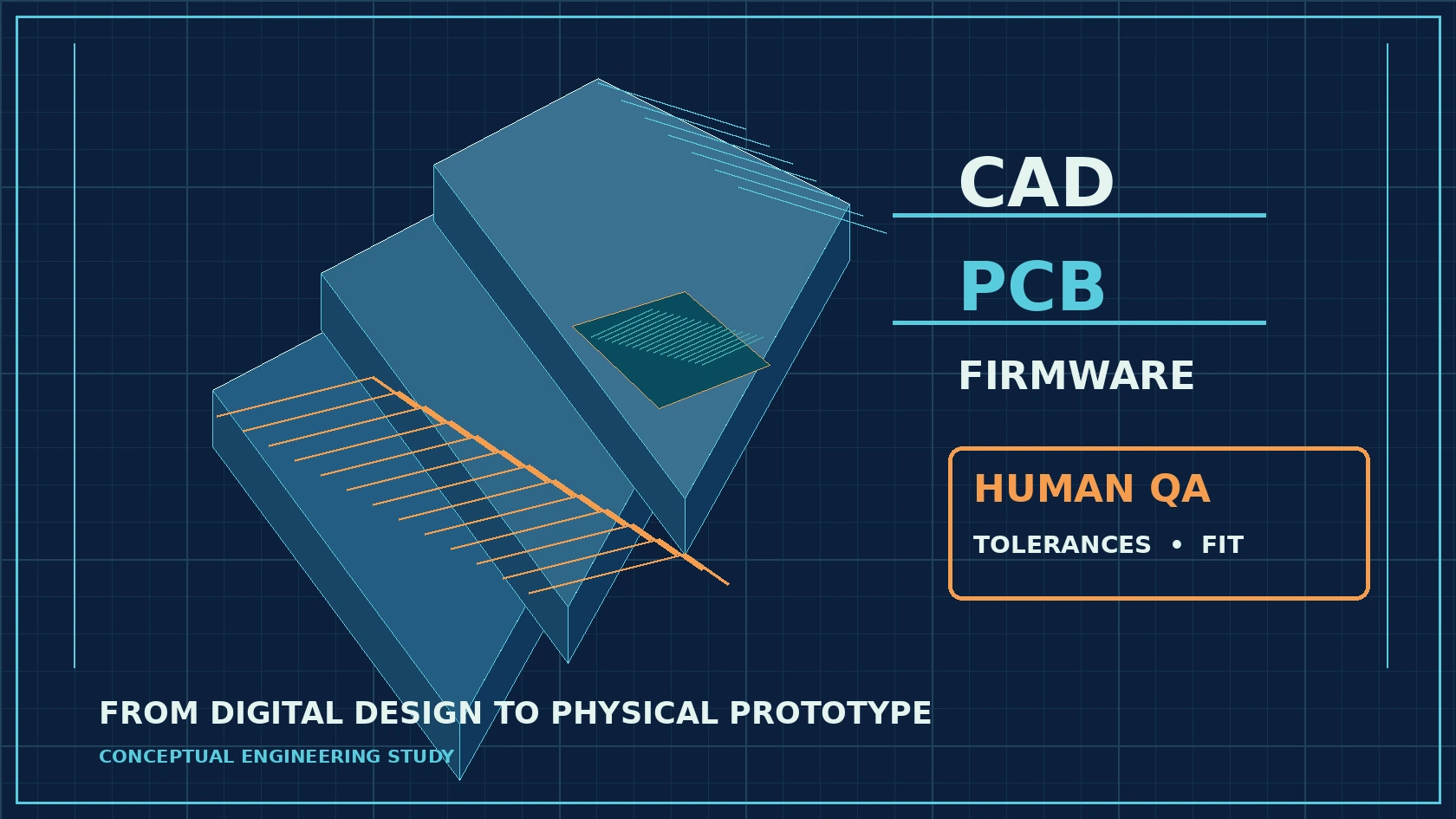
OpenAI says two of its employees and GPT-6 Astra designed a small device for speaking to Codex in less than a week, and a contract manufacturer built a prototype batch in under a month. The demonstration, described on 3 November 2026, spans enclosure design, electronics and firmware. The important constraint is equally clear: the model’s design still required several rounds of human review and iteration to satisfy production tolerances and assembly requirements.
The account appears in OpenAI's engineering announcement alongside other internal workflows involving computer-aided design, printed circuit boards, simulations and manufacturing drawings.
The test device covered more than one engineering discipline
According to OpenAI, the test began with a functional specification for a physical device capable of connecting a user to Codex. Astra created industrial-design concepts, a mechanical enclosure and internal mounting features, selected electrical components, laid out a PCB that would fit the case and generated interface and firmware software. The account describes the two staff members as coordinating the side project rather than directly editing each design artifact.
Cross-disciplinary consistency is a substantial engineering challenge. The board must fit mechanical clearances; connectors and thermal loads affect the enclosure; the firmware must match actual electronic components; and drawings sent to a manufacturer must be explicit enough to fabricate. A convincing CAD render alone is not evidence that an artifact will pass those constraints.
A manufactured prototype is not proof of production readiness
OpenAI says a contract manufacturer made a small batch, but that preparation for manufacturing required several rounds of review and iteration. Astra did not reliably anticipate the manufacturer's production constraints, tolerances and assembly details. The account offers a useful demonstration of assistance across a workflow, not a claim that autonomous engineering is ready to replace safety-critical design sign-off.
Those distinctions matter for teams considering AI-generated printed circuit boards and mechanical parts. Functional prototypes require electrical testing, fit checks, thermal and mechanical validation, manufacturing quality assurance and regulatory assessment where applicable. Automated output can accelerate proposals and revisions while still imposing verification work on human engineers.
A contemporaneous technical overview summarizes the prototype case and OpenAI's early external collaborations, while also noting the repeated manufacturing review.
Where the models are already being used
OpenAI reports that its hardware teams use Codex and ChatGPT for CAD revisions, turning 3D models into production drawings, setting up finite-element analyses, checking electrical layouts and coordinating design changes. Across internal hardware teams, model usage measured in tokens has risen 23-fold since February. Token volume is an adoption metric, not a measured 23-fold improvement in engineering productivity.
The company also describes work with Chip Ganassi Racing to convert scans of physical parts into editable CAD and manufacturing drawings, and with Mazda to investigate vehicle designs through simulation. The engineers involved remain responsible for checking accuracy and whether output can be manufactured.
A promising benchmark with an important limit
OpenAI reports a score of 0.875 for a newer internal model on its BenchCAD 2.0 engineering benchmark, versus 0.594 for GPT-6 Astra at the stated highest reasoning setting. The benchmark includes reconstructing 3D parts and assemblies and identifying connections in circuit boards. That is evidence of improved performance on selected evaluation tasks, not a certification of structural integrity, regulatory compliance or complete product-design autonomy.
For background on the model's computer-use capabilities, OpenAI's GPT-6 Astra introduction includes a condensed demonstration involving PCB layout in KiCad. A short demonstration does not quantify the reliability of every engineering task.
A disciplined way to adopt AI engineering tools
For a hardware team, the defensible pilot is constrained. Choose repetitive tasks such as drafting initial CAD geometry, generating documentation, checking schematic consistency or setting up a non-critical simulation. Define dimensional tolerances, component availability and inspection criteria before the assistant begins. Have an experienced engineer test model outputs against source drawings and known physical constraints, then measure hours saved after corrections, not merely the time to the first render.
If the approach proves dependable, engineers could spend more time evaluating alternatives rather than reconstructing routine CAD and PCB artifacts. But that payoff depends on verification. OpenAI's most instructive result may be that an AI can help bring a prototype into the physical world while still stumbling on the ordinary manufacturing details that separate an appealing design from a producible one.
Publication history
— First published.
No published corrections or earlier versions.
How this was made
UpThat uses AI-assisted research and writing. Source checking and publication follow our editorial review workflow. See the original documents above to assess the reporting.
How we use AI ↗