How octopuses squeeze through tiny holes—and what a small study cannot prove
Researchers identified three- and four-step movements. But each common octopus was tested at one relative hole size, leaving individual differences unresolved.
 Editorial visualization
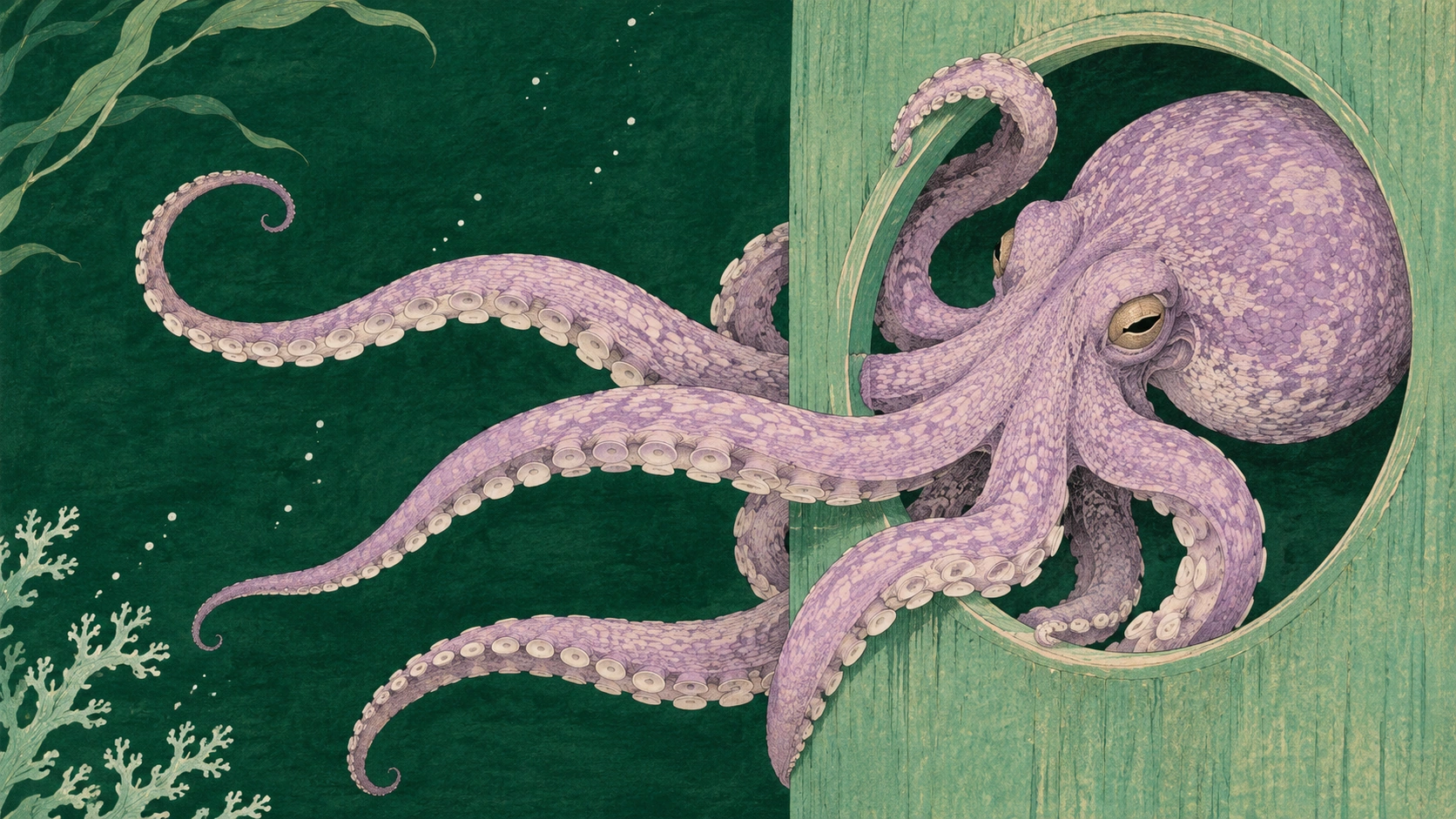
A study published November 5 in the Journal of Experimental Biology identifies two recurring ways octopuses squeeze through openings. The crucial caveat: each common octopus experienced only one relative hole-size condition.
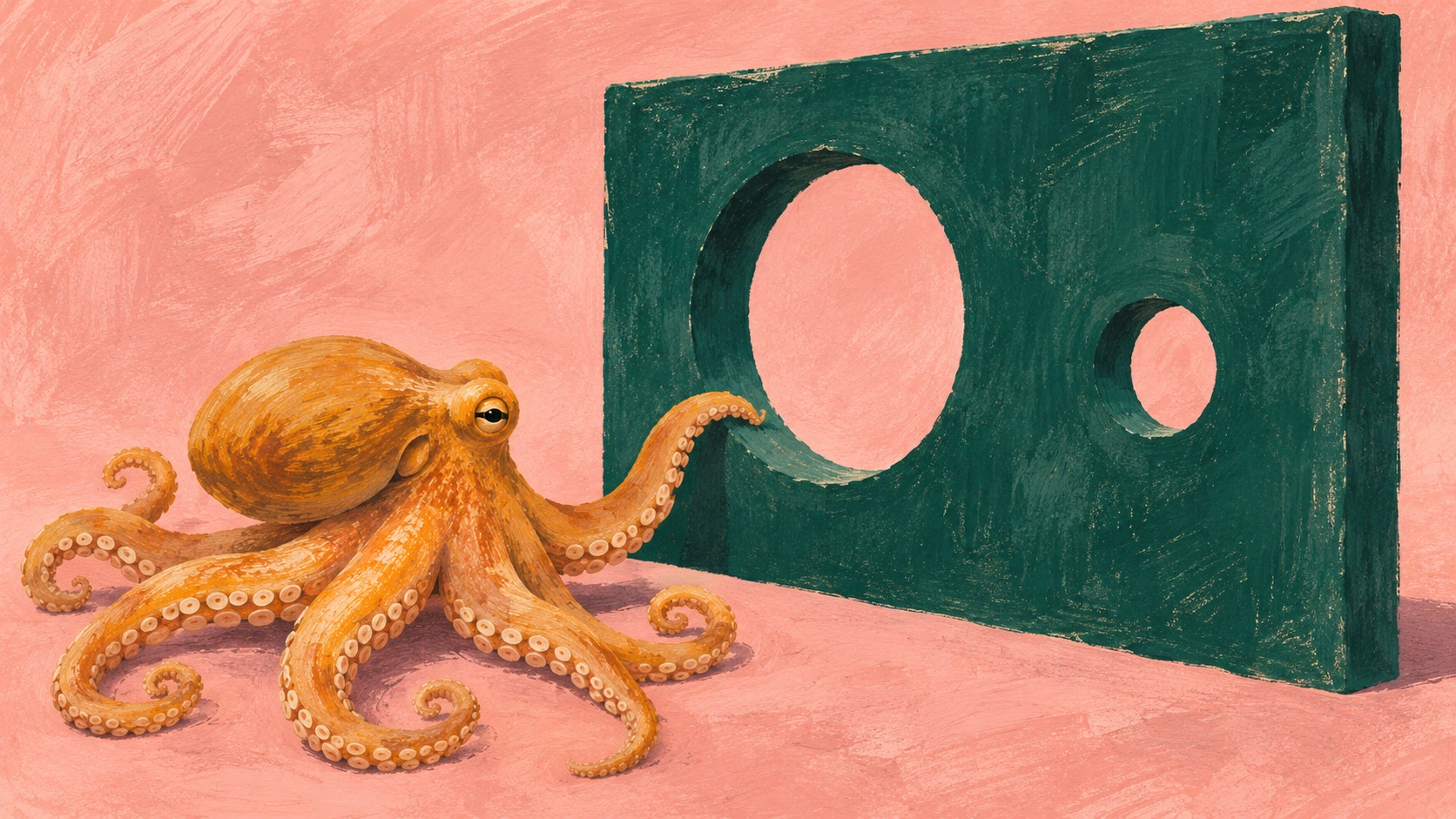
The finding concerns coordination, rather than a newly discovered ability to deform. In the publisher’s account, researchers used holes sized relative to the distance between the animals’ eyes, a proxy for the cartilage surrounding the central nervous system. A gap small beside the mantle can still demand different movements depending on the animal facing it.
The arms provide purchase
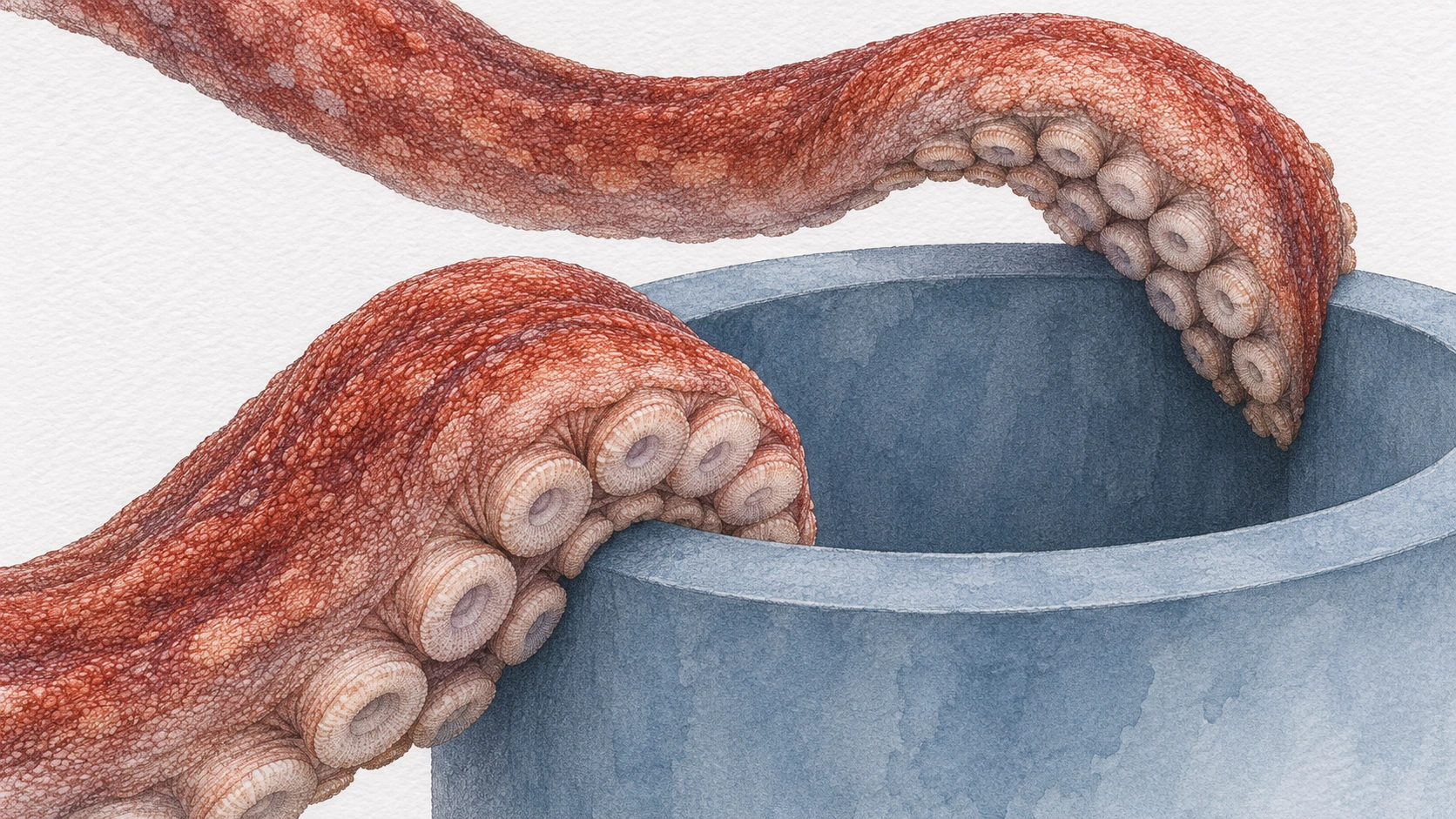
In an accompanying interview, lead author Wenci Xin describes a shared beginning: arms explore beyond the opening, then more arms pass through and position themselves to help move the body. For a relatively roomy hole, those arms brace against the surrounding surface and the remaining arms and body follow together. The tighter sequence separates that final passage: remaining arms first, then the head and mantle.
That distinction gives the observation its engineering interest. A deformable body still needs a way to coordinate contact with its surroundings. Flexibility alone does not describe the order in which its parts move.
 Editorial visualization
The comparison involved different individuals
The original methods describe three common octopuses and four juvenile Mayan octopuses. These were different individuals, not a large population.
| Individuals | Hole diameter | Distance between eyes | Relative condition |
|---|---|---|---|
| Common octopus 1 | 20 mm | 15–20 mm | Larger-hole condition |
| Common octopuses 2 and 3 | 30 mm | 30–35 mm | Smaller-hole condition |
Individual preferences remain an alternative explanation for the pattern. Repeated trials do not enlarge the biological sample, and the authors call for more animals and multiple hole sizes.
The paper reports unsuccessful smaller-hole passages by Mayan octopuses, with success at a larger opening. Non-passage does not prove physical impossibility. Recordings also did not permit systematic mantle analysis.
Independent reporting by Science News adds an outside perspective: evolutionary biologist Robyn Crook, who was not involved, suggests testing other geometries such as slits and tubes. Those shapes could require different movements. The present results do not establish one escape routine for all openings or species.
 Editorial visualization
A robotics lead, not a finished rescue machine
Xin’s interview frames neural coordination as a future research question. The study describes movements; it does not settle how the nervous system produces them. Likewise, using the sequences to guide soft-robot design is a proposed application, not evidence of a working search-and-rescue system.
A stronger next experiment would expose the same individuals to several relative opening sizes. That would help separate a response to geometry from an animal’s habitual strategy—the distinction this small study cannot yet resolve.
Publication history
— First published.
No published corrections or earlier versions.
How this was made
UpThat uses AI-assisted research and writing. Source checking and publication follow our editorial review workflow. See the original documents above to assess the reporting.
How we use AI ↗