Hera’s first close-up shows Didymos. The DART investigation comes next.
The new view reveals the larger asteroid, while DART’s smaller target is mostly in shadow. Hera’s task is to explain the deflection already measured from Earth.
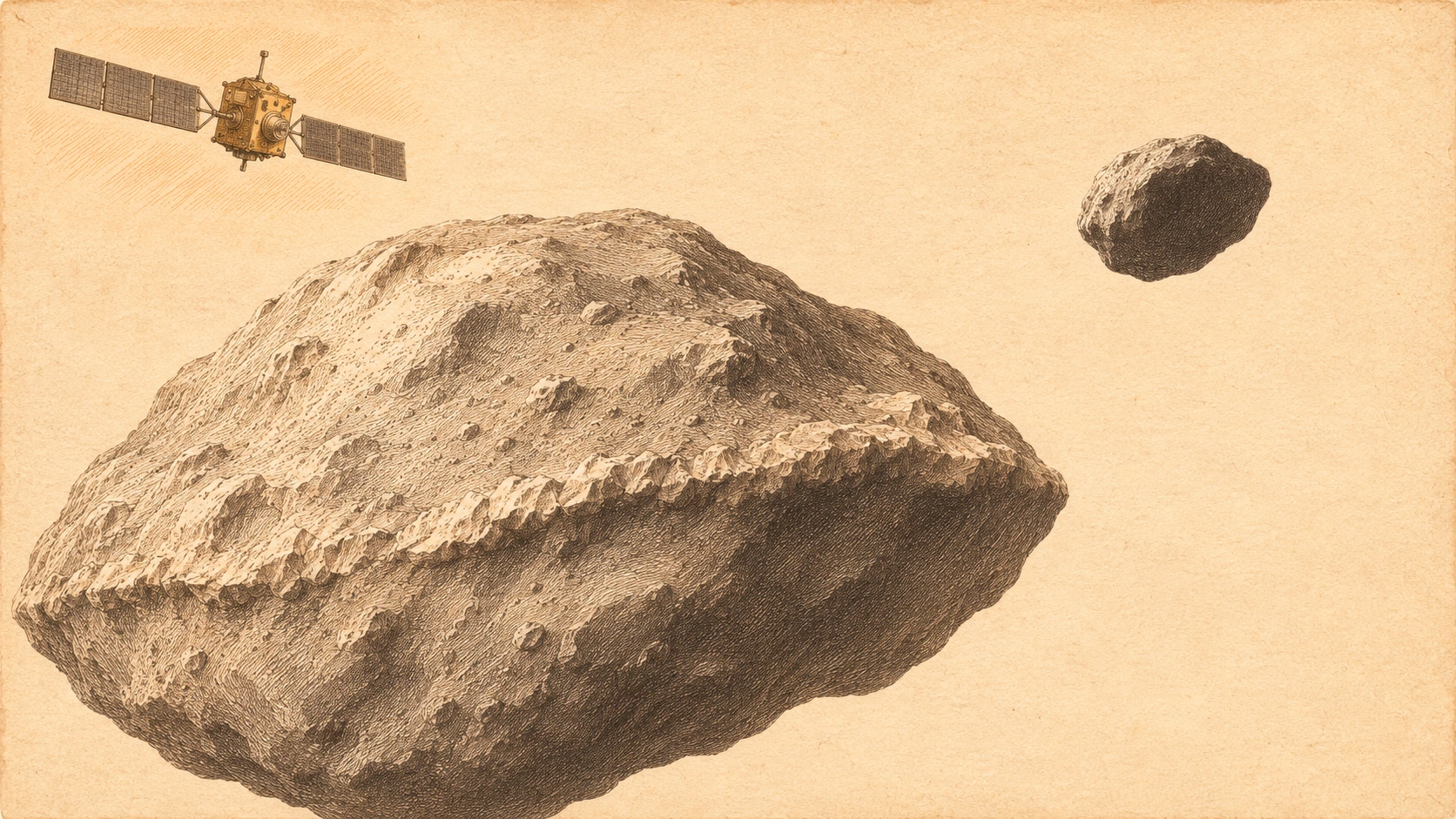 Editorial visualization
ESA’s Hera spacecraft has returned a close-up of the Didymos asteroid system from about 60 kilometres away. The view shows a side of the larger asteroid that DART did not see before its 2022 collision with the smaller Dimorphos. Dimorphos itself is mostly hidden in shadow in the image announced by ESA on November 5.
The visible surface includes an equatorial ridge, boulders, craters and possible grooves or ridges. Scientists suspect some features could reflect material transferred from Dimorphos after the impact, but that remains a question for investigation. A detailed view of DART’s impact site is not the result being announced here. ESA describes the new image and its limits.
Spacecraft builder OHB’s November 6 update says Hera remains on its final approach and has completed deployment rehearsals for its two accompanying CubeSats, Juventas and Milani. It points to November 25 for the unveiling of detailed images of both asteroids. That is a forthcoming milestone, not a completed survey. Read OHB’s mission update.
DART changed the orbit. Hera must explain the response.
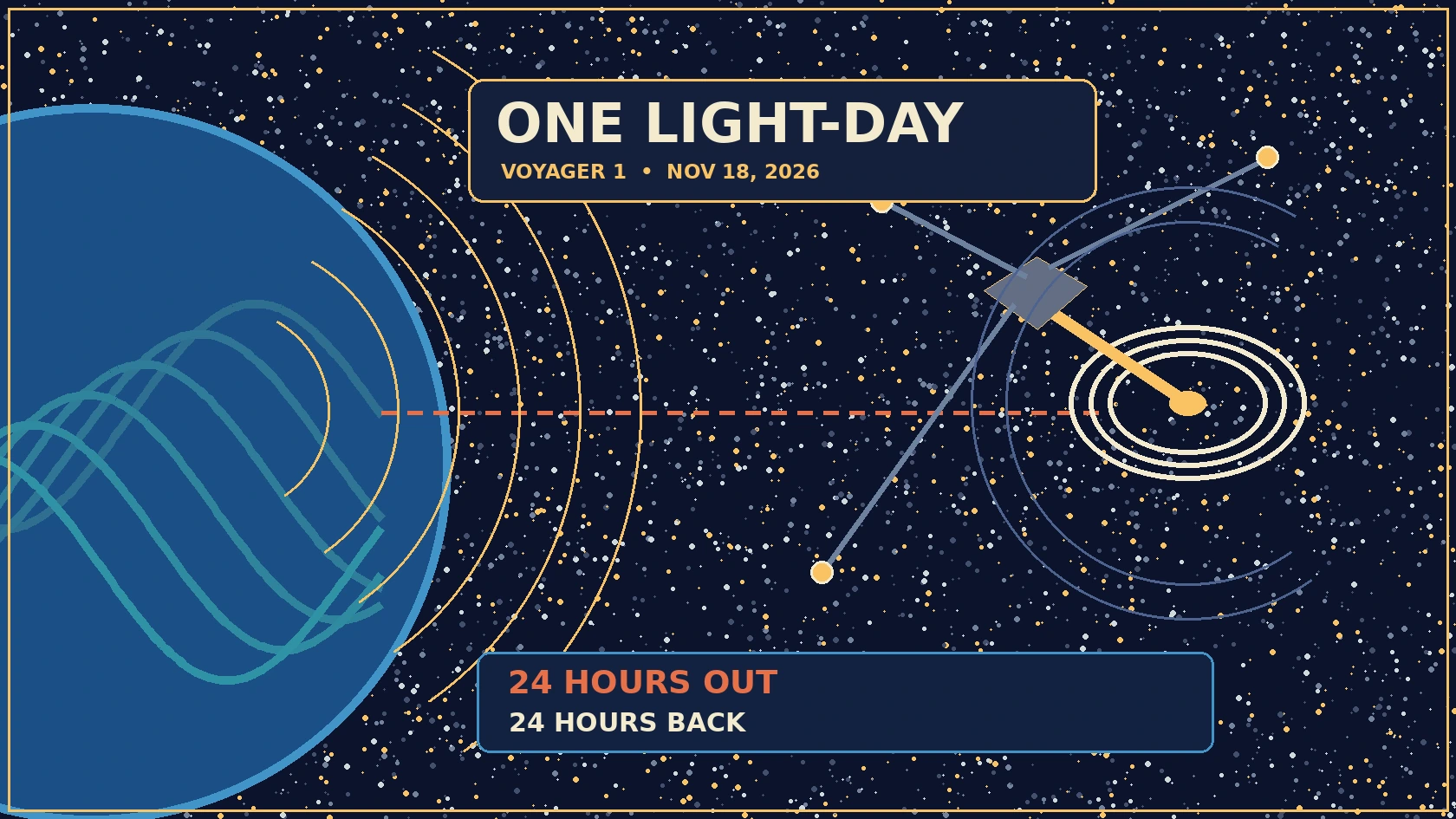
DART deliberately struck Dimorphos on September 26, 2022. Ground observations already established that the moonlet began circling Didymos more quickly. A NASA/JPL study published in March 2024 reconstructed its settled post-impact orbital period as 11 hours, 22 minutes and 3 seconds—33 minutes and 15 seconds shorter than before the collision. NASA explains the reconstructed orbital change.
That result was assembled from several kinds of evidence, rather than a spacecraft watching the entire aftermath at close range. The researchers combined DART’s approach images, radar measurements of the asteroids’ relative positions and velocities, and telescope observations of changing brightness as the bodies passed in front of or behind each other. Their models also inferred that Dimorphos became more elongated. The study describes those methods and shape inference.
Hera adds a different kind of evidence: a close survey of what was hit and what remains. CNES, a mission partner, identifies the still-uncertain mass of Dimorphos as essential to determining how effectively the impact deflected it. Changing the motion of an object is easier to interpret when its mass is known; the observed orbital change alone leaves part of that physical accounting unresolved. CNES sets out Hera’s measurement objectives.
The missing details determine whether one test can guide another
Debris explains why the spacecraft’s own momentum is only part of the story. NASA’s 2023 analysis found that material thrown out by the impact recoiled against Dimorphos, adding to the push. The amount of material, and the way an asteroid responds, help determine the effectiveness of a kinetic impact. NASA describes that momentum enhancement.
Juventas is intended to probe the asteroid’s interior using radar, allowing scientists to compare observations with models of its internal structure. These measurements, together with mass and surface information, are planned investigations. The new image does not yet establish the interior’s properties or a finished explanation of the deflection. CNES describes the radar investigation.
Didymos and Dimorphos do not pose a threat to Earth, ESA states. They provide a test system for learning how an intentional impact changes a small body’s motion. Hera’s value is therefore not an emergency intervention: it is the chance to reduce the uncertainty in designing a future deflection for an asteroid with a different mass, structure or surface. ESA explains why this pair was selected.
Publication history
— First published.
No published corrections or earlier versions.
How this was made
UpThat uses AI-assisted research and writing. Source checking and publication follow our editorial review workflow. See the original documents above to assess the reporting.
How we use AI ↗