Why Indonesia’s November rain warnings do not cancel its dry spell
BMKG’s November 6 bulletin flags heavy rain for the week ahead while dry conditions persist elsewhere. The explanation lies in different weather processes and timescales.
 Editorial visualization
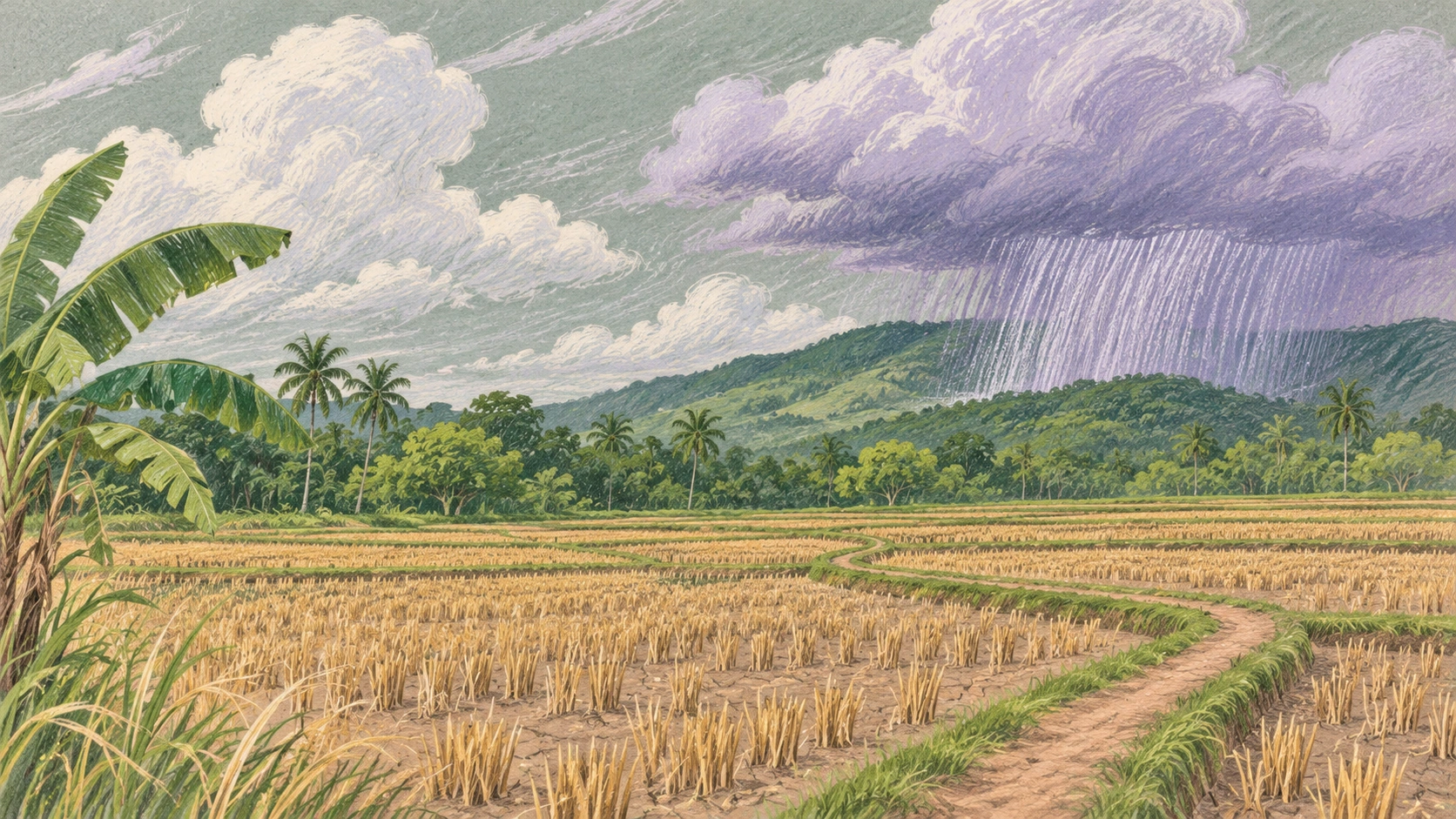
BMKG’s November 6–12 outlook, posted November 6, flags heavy-rain risks while parts of Indonesia remain dry. The apparent contradiction reflects different atmospheric processes and timescales: a dry climate background does not rule out a dangerous local downpour.
The contrast is already visible in recent observations. In its November 5 bulletin, BMKG reported daily maximum temperatures above 37°C in parts of Lampung, West Nusa Tenggara, East Nusa Tenggara, South Kalimantan and South Papua during October 29–November 1. The same bulletin reported heavy daily rain in several regions, including 88 millimeters in South Kalimantan. These are regional observations across a period, not proof of identical conditions at one place and hour.
A background tendency does not set every day’s weather
BMKG attributed suppressed rain-cloud formation in some areas to a very strong El Niño and a positive Indian Ocean Dipole in that November 5 assessment. It also identified atmospheric waves, moist air, converging winds and atmospheric instability as mechanisms that can support local rain-cloud development despite the drier background.
One of those influences is the Madden–Julian Oscillation, or MJO. NOAA’s Physical Sciences Laboratory describes it as an eastward-moving disturbance in tropical clouds, rain, winds and pressure, typically circling back to its starting point over 30–60 days. It changes where tropical rainfall is enhanced or suppressed; it is not a permanent switch that makes the whole country wet.
The distinction is between the tendency over a wider area and period, and the conditions that allow an individual rain system to form. Moisture and winds can concentrate rainfall in one region while another remains dry. A heavy shower therefore does not, by itself, establish that a broader dry spell has ended.
BMKG’s earlier October 29 outlook
Publication history
— First published.
No published corrections or earlier versions.
How this was made
UpThat uses AI-assisted research and writing. Source checking and publication follow our editorial review workflow. See the original documents above to assess the reporting.
How we use AI ↗