A digitized book needs more than a folder of pictures
IIIF gives compatible viewers both image requests and an object's presentation structure. That helps pages travel together, while rights still need attention.
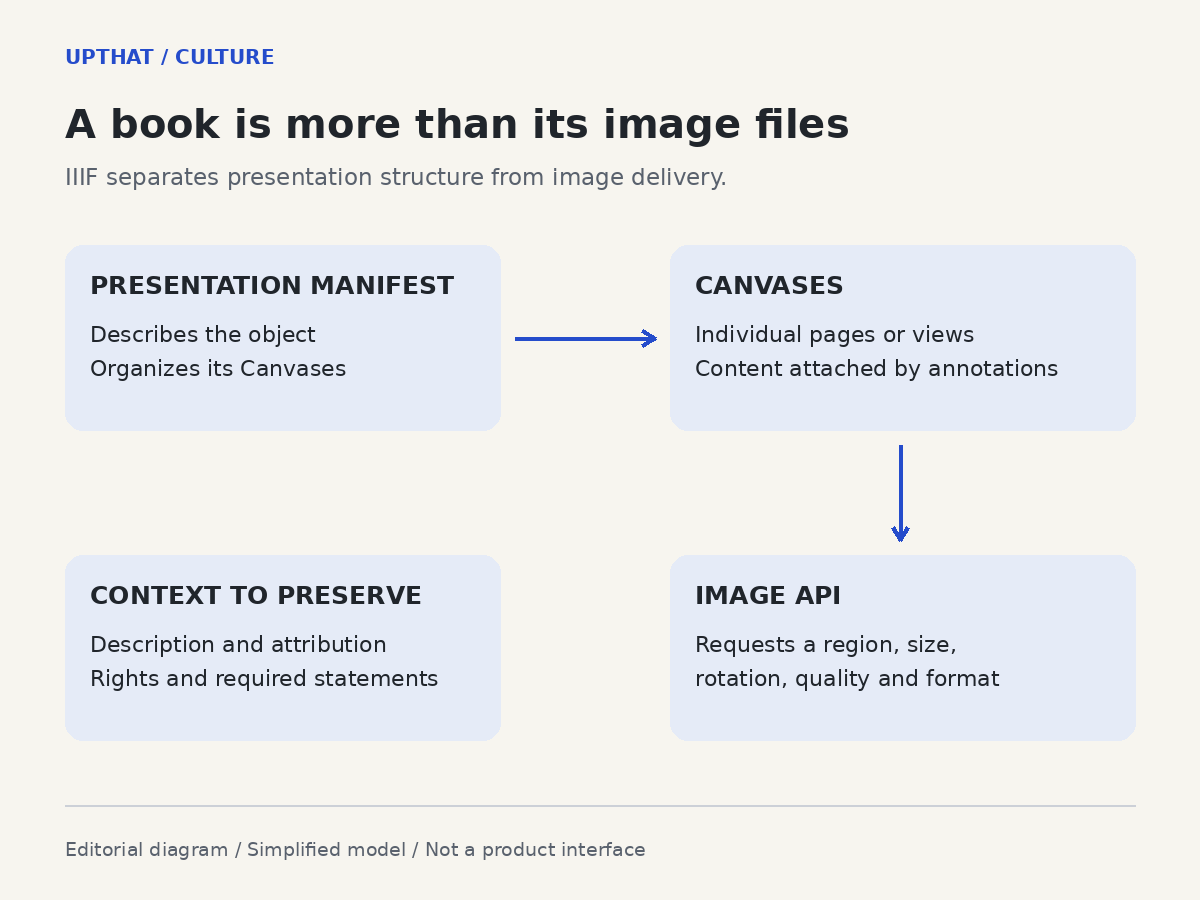
A folder can hold every scanned page of a book and still leave the reader with work to do: find the order, identify the object and work out which institution supplied it. Delivering the pictures is one problem. Describing how they belong together is another.
The International Image Interoperability Framework, or IIIF, addresses both through separate specifications. Its Image API handles image delivery; its Presentation API describes the structure and presentation of digital objects. A compatible viewer can use those shared conventions instead of requiring a custom arrangement for every collection.
Imagine a book as a sequence of surfaces to display. In the Presentation API, a Manifest describes the object, while Canvases provide spaces on which content is presented. Image content is associated with those spaces. This is a conceptual example, not a description of a particular digitization project.
The distinction becomes useful when the image and its presentation are not identical: the object has structure beyond a collection of files.
Asking for a detail
The Image API lets a request specify a region, size, rotation, quality and format. A viewer can request a detail or a suitable representation rather than rely on one fixed-size file for every purpose.
IIIF's museums group describes dynamic derivatives and reuse of regions as practical benefits. It also describes exhibits drawing on images from multiple repositories. These are capabilities and community use cases, not a measurement that every collection has implemented them.
Taken together, the two layers offer a way to carry a viewing experience across institutional boundaries: one convention for requesting images, another for explaining their arrangement. That is the editorial significance of interoperability here. It reduces the need to reinvent the exchange without requiring the collections themselves to become identical.
Context has to be displayed, too
A Manifest can include descriptive information and a rights statement. Its requiredStatement property supplies text that a viewer must display, such as an acknowledgment or ownership notice. A viewer that shows the image while hiding that information can lose part of what made the object intelligible.
The museums documentation covers both open and restricted content, including authorization for restricted images. Being accessible through a compatible viewer therefore does not establish permission to republish a particular picture.
Nor does a shared format verify a catalogue's assertions. Structure can help information travel; the supplying institution remains the source of that description. For anyone comparing objects across collections, the useful question is what the viewer preserves alongside the pixels: identity, order, attribution and the conditions attached to use.
Publication history
— First published.
How this was made
UpThat uses AI-assisted research and writing. Source checking and publication follow our editorial review workflow. See the original documents above to assess the reporting.
How we use AI ↗