UVEX moves toward construction, with an ultraviolet map of the sky ahead
NASA has confirmed the mission’s development baseline. The next step is building the observatory, not releasing a new sky map.
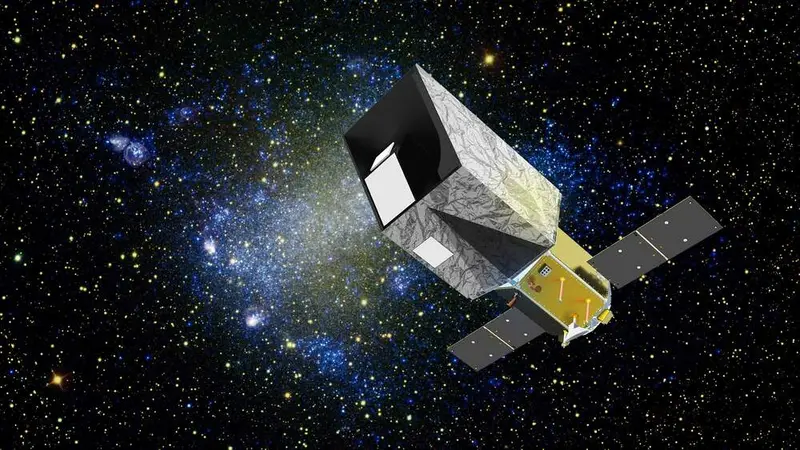
UVEX has to solve two different problems: find faint ultraviolet sources across the sky, and turn quickly enough to catch objects that are changing. NASA’s latest approval moves the proposed observatory toward construction. The scientific payoff would come from doing both jobs with the same telescope.
In an announcement published on October 27, 2026, NASA said the mission had passed Key Decision Point C, its technical and programmatic review. The agency committed to launch by January 2031 at a total lifecycle cost of $590 million. Berkeley’s Space Sciences Laboratory, which manages the Caltech-led mission, describes the next phase as completing instrument designs before hardware production.
A map that can reveal change
The survey is intended to establish a baseline ultraviolet view of the sky. Berkeley explains that subsequent scans can then be compared with that first view to identify changes worth investigating. A single image records what was present; repeated observations let astronomers ask what has appeared, brightened or faded.
UVEX would also respond to alerts from other observatories. NASA identifies the aftermath of merging neutron stars as one target. Such events connect two kinds of observation: gravitational waves signal the merger, while light lets telescopes investigate its aftermath. Catching the ultraviolet emission requires observations while the source is still changing.
Images alone do not provide every answer. UVEX also carries a planned spectroscopic capability, splitting light by wavelength so astronomers can investigate a source’s composition. The distinction matters: locating an event and examining the light it produces are related tasks, but they yield different information.
Inside the ultraviolet camera
Berkeley describes an optical system in which incoming light is focused by three mirrors and divided into far-ultraviolet and near-ultraviolet imaging channels. Each detector has a coating selected for its wavelength range. A separate spectrograph sensor spans both bands.
Those sensors draw on CMOS technology, the family used in ordinary digital cameras, but the telescope cannot simply fly a consumer camera into space. Its detectors and coatings are adapted for ultraviolet light. Berkeley says this approach is intended to let UVEX observe bright ultraviolet regions that constrained its predecessor, GALEX.
That opens a route to studying nearby dwarf galaxies, including the Magellanic Clouds. Their relatively low abundance of heavy elements offers a way to examine environments resembling some conditions in early galaxies. These are nearby laboratories for a question that otherwise pushes astronomers toward much more distant objects.
Ultraviolet coverage also adds context to observations made at visible and infrared wavelengths. The useful comparison is between measurements of the same sky, rather than a contest over which telescope produces the most striking picture.
The hard part before first light
Making that camera work requires unusually careful calibration. Berkeley reports that gases released by instrument electronics can settle on sensitive surfaces and absorb ultraviolet light. Keeping the instrument clean is therefore part of preserving its ability to detect the signal it was built to measure.
A custom calibration facility is being prepared at Berkeley to test the instrument in vacuum and at low temperatures. An ultraviolet light source will help technicians check optical alignment and detector sensitivity. This is where the development milestone becomes practical work: the proposed observing capabilities have to survive construction, integration and testing.
NASA’s dated commitment is to launch by January 2031; older project material still gives 2030. The October 27 announcement does not identify the exact day the review concluded. NASA, Caltech and Berkeley are all involved in the mission, so their accounts establish the plans and development status rather than independently demonstrating future performance.
The first ultraviolet baseline image will eventually give the survey something to compare against. Before then, the comparison that matters is between the instrument’s promised capabilities and what its builders can verify on the ground.
Publication history
— First published.
No published corrections or earlier versions.
How this was made
UpThat uses AI-assisted research and writing. Source checking and publication follow our editorial review workflow. See the original documents above to assess the reporting.
How we use AI ↗