TRACERS’ first results point to patchiness in magnetic reconnection
Paired satellite measurements favor differences across locations in an initial sample. The researchers say more observations are needed.
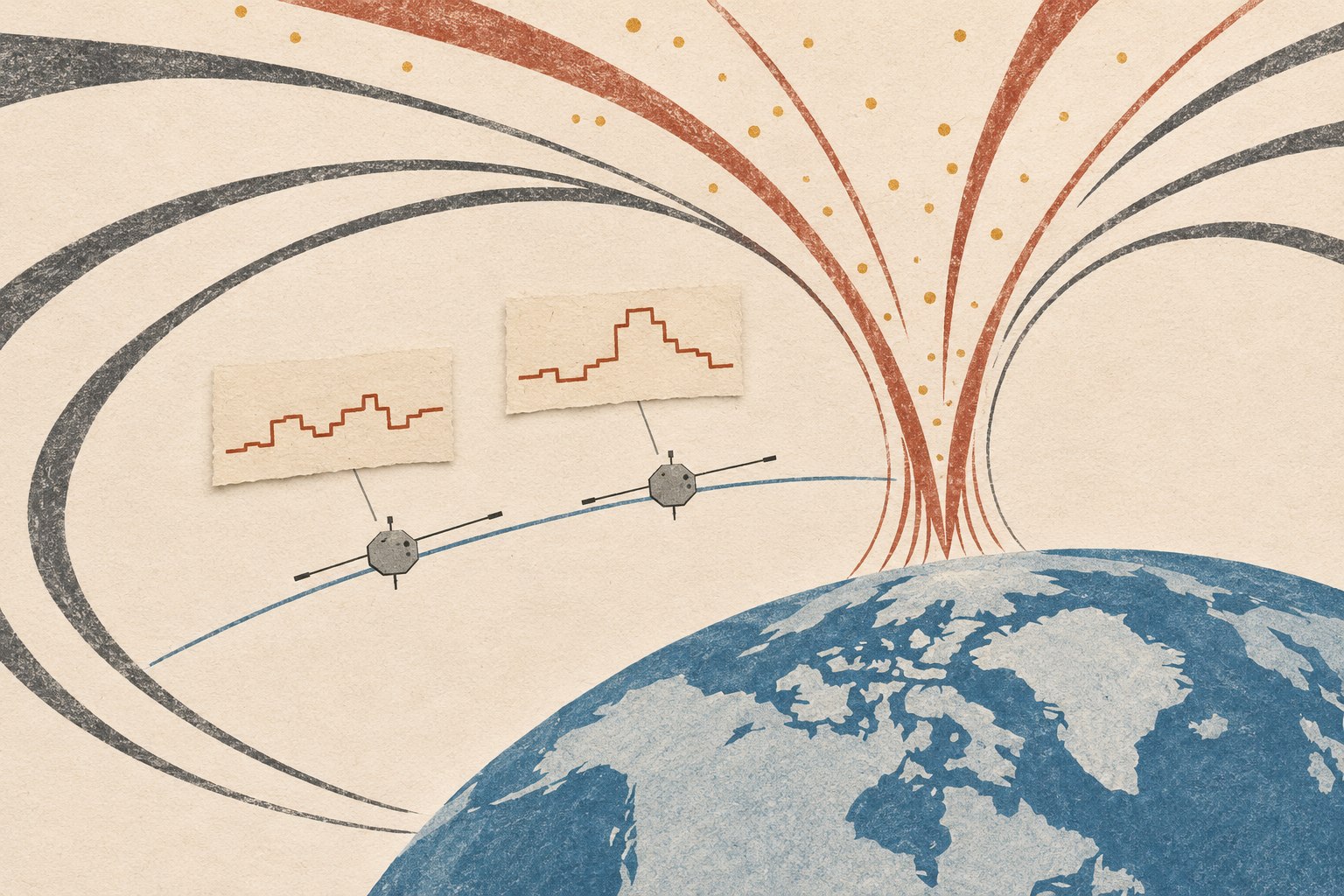 Editorial visualization
A spacecraft can encounter a changing particle pattern because it has crossed into a different region, or because the environment changed while it was passing through. NASA’s TRACERS mission uses two spacecraft following one another to help tell those explanations apart.
Its first results, published on October 29 in the Journal of Geophysical Research: Space Physics, favor differences across locations in an initial sample of 207 paired cusp encounters. The observations cover November 2025 through February 2026. The authors describe the finding as preliminary.
The question concerns magnetic reconnection, a process that transfers energy and charged particles between the solar wind and Earth’s magnetic environment. The boundary between them is called the magnetopause. Near the poles, funnel-shaped regions called cusps provide a place to study particles linked to that interaction.
The University of Iowa’s mission explanation describes the paired measurements as successive snapshots. If an ion structure appears at the same latitude in both, that supports a spatial interpretation. A structure that shifts in latitude between snapshots can indicate temporal variation. Comparing the two helps researchers interpret patterns that would be harder to distinguish with one spacecraft.
A first sample, with limits
The study used the satellites’ Analyzers for Cusp Ions to classify the encounters. Spatial variation dominated across the magnetic-field orientations and solar-wind pressure ranges examined. That does not mean time ceased to matter: the authors report temporal changes embedded in almost every encounter classified as spatial.
The dataset is about one tenth of the number of cusp encounters originally planned for the mission. The paper also acknowledges subjectivity in separating ambiguous cases from spatial or temporal ones. More observations are needed to confirm the pattern and untangle how solar-wind conditions influence it.
NASA’s October 29 announcement describes a recovery effort after a problem with one spacecraft and says both now routinely observe the southern cusp. The agency approved an extension in September to continue the prime mission into spring 2027. That gives the team a route to collecting the additional measurements its paper calls for.
The public relevance is space weather. NASA links understanding reconnection to the broader effort to predict geomagnetic storms, which can affect communications, power grids and astronauts. These first results establish neither a new operational forecast nor a warning of an imminent storm.
A larger set of paired crossings will let the team test whether the pattern persists when magnetic-field direction and solar-wind pressure are examined together, rather than only in separate groupings.
Publication history
— First published.
No published corrections or earlier versions.
How this was made
UpThat uses AI-assisted research and writing. Source checking and publication follow our editorial review workflow. See the original documents above to assess the reporting.
How we use AI ↗