A Sahara meteorite preserves a rare record of ancient Mars
Teghaza 001 formed at least 4.1 billion years ago. A new study connects its unusual minerals to ancient Martian crust, while earlier work traces water through the same rock.
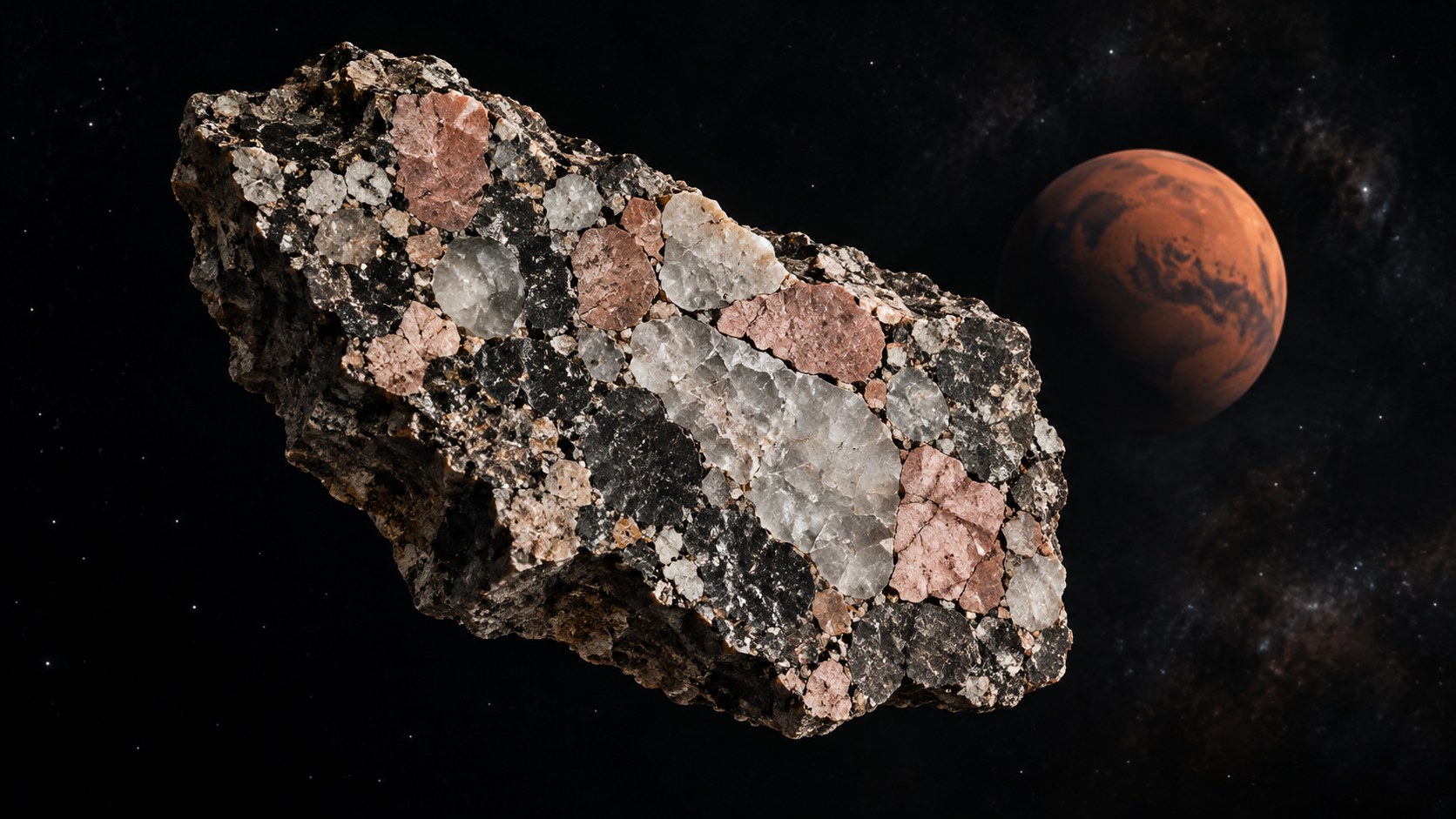 Editorial visualization
A rose-colored rock recovered in Mali in 2022 carries a history that began on another planet. Teghaza 001 formed at least 4.1 billion years ago, and its minerals preserve evidence of water interacting with ancient Martian crust before an impact launched it into space.
A study published in Science on October 29, 2026, describes the meteorite as a slowly cooled igneous rock with a composition and texture unlike other known Martian samples. The discovery date and the publication date are different: the new work concerns what scientists have learned from the rock, not a meteorite found this week.
Its value is partly a gap in the collection. Much of Mars’ surface is ancient, but most Martian meteorites available to researchers are geologically young. In the study’s abstract, the authors identify Teghaza 001 as a piece of old crust derived from a chemically distinct source in the planet’s mantle.
The rock contains more than one clock
JPL reports that researchers established its Martian origin by matching oxygen isotopes with other Mars meteorites. These are versions of oxygen with different masses, whose proportions help distinguish planetary materials.
The team found zircon crystals and investigated the rock’s formation and alteration. According to JPL, a rubidium-strontium dating technique examined individual grains on a piece smaller than a fingernail, preserving scarce material instead of dissolving an entire sample.
JPL says Martian water altered the rock around 4.1 billion years ago, implying earlier formation. The Science abstract describes its formation age as at least 4.1 billion years. One exact date cannot stand for every stage of that history.
Water left chemical traces
The October study combines water-altered minerals with oxygen-isotope measurements to infer reactions with fluids enriched in oxygen-18 before the meteorite left Mars. This is a reconstruction from mineral chemistry, not an observation of ancient water itself.
Water in this specimen was already the subject of a separate Science Advances paper published June 10. That study measured water content and hydrogen isotopes in calcium-phosphate minerals. Its authors interpreted the measurements as mixing between magmatic water and another component carrying the imprint of an ancient Martian water reservoir.
Hydrogen comes in a light form and a heavier form, deuterium. The researchers estimated a lower bound for the ancient reservoir’s deuterium-to-hydrogen ratio of roughly twice that in Earth’s seawater. They reported that this supports models in which Mars lost hydrogen to space early in its history.
Those results describe water moving through a geological system. They do not establish that organisms lived there. The June and October papers also share researchers and a specimen: they add different measurements to the same investigation, rather than representing independent discoveries of another ancient rock.
Teghaza 001 belongs to the Maine Mineral & Gem Museum’s collection in Bethel. The museum emphasizes its unusual mineralogy and the opportunity to study early crust directly. A specimen held on Earth lets researchers revisit questions with additional analyses as methods develop.
Its address on Mars remains uncertain. JPL reports 13 possible locations matching the chemistry and mineralogy, with similarities to the southern highlands. Those candidates do not establish a departure point. The laboratory record is unusually old; its precise origin is still unresolved.
Publication history
— First published.
No published corrections or earlier versions.
How this was made
UpThat uses AI-assisted research and writing. Source checking and publication follow our editorial review workflow. See the original documents above to assess the reporting.
How we use AI ↗