SMX01 enters service in Jakarta, with AI capacity arriving in phases
The operator reports 21 MW of IT capacity. Cooling phases and different power figures show why a data-center opening is only one measure of AI readiness.
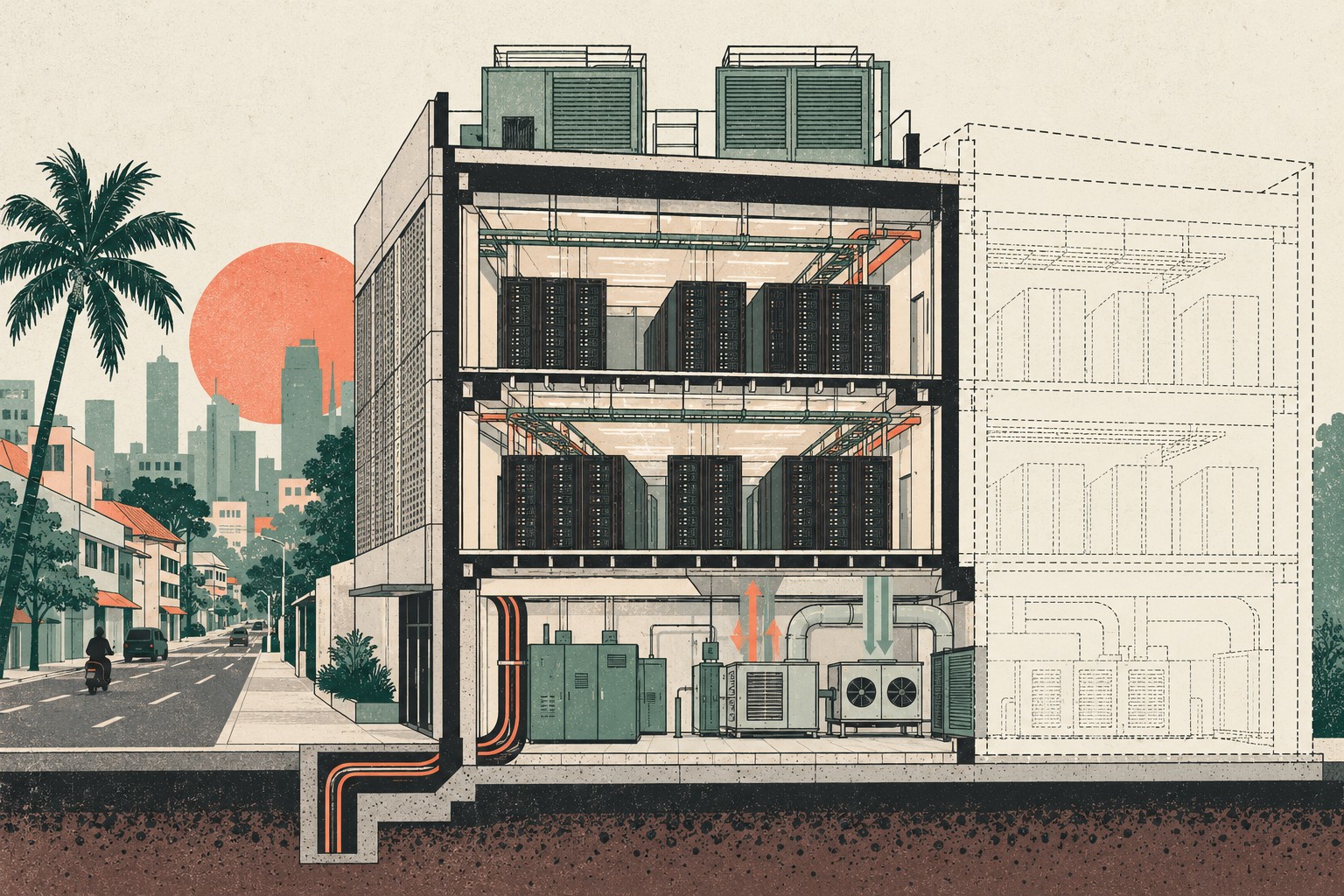 Editorial visualization
SMX01 has entered service in Jakarta’s central business district, adding a reported 21 megawatts of IT load capacity. Operator SM+ Data Centers announced the milestone on November 1; coverage followed on November 2. The launch moves the facility into operations, with customer onboarding and stabilization next.
SM+ owns and manages the facility, Korea Investment Real Asset Management is the investment partner, and LG Sinar Mas—the LG CNS–SM+ joint venture—leads design, construction and technical operations.
The operator describes a carrier-neutral facility with multiple internet providers and four network entry points. That connectivity matters alongside physical capacity: computing needs routes to its users.
What is available, and what comes later
LG CNS’s November 2 announcement describes completion of a 30-MW-class Jakarta AI data center. Yonhap also reported the company’s completion announcement. LG CNS says the first phase uses air cooling, with liquid cooling to be added in a subsequent phase.
That timing matters. A design capable of supporting future high-density computing does not establish that every cooling configuration is already installed. SM+ describes the ability to use liquid cooling across its data halls alongside air cooling, while LG CNS sets out a phased installation plan. The narrower claim is readiness for staged deployment.
The capacity figures also need their labels. SM+ explicitly identifies 21 MW as IT load capacity. LG CNS uses the 30-MW description and says later development would bring total incoming-power capacity to 400 MW. That larger number is a future target, not capacity delivered by this opening.
The announcements do not fully reconcile those figures on a common basis. They should not be added together or used to infer current equipment utilization, computing performance or energy efficiency. A stated capacity is not evidence that an equivalent load of AI servers is already running.
Cooling is also a commercial commitment
In a July discussion, SM+ had already framed cooling choices as decisions affecting construction costs, operating expenses, available IT capacity and customer commitments. Its explanation is useful context for this opening: the way a facility removes heat helps determine which workloads it can support and what it costs to operate.
These remain company descriptions of design and readiness, rather than independent measurements of sustained performance. The practical evidence to watch next is customer deployment: which halls and cooling systems are in service, what workloads they support, and how the facility performs under those loads.
Publication history
— First published.
No published corrections or earlier versions.
How this was made
UpThat uses AI-assisted research and writing. Source checking and publication follow our editorial review workflow. See the original documents above to assess the reporting.
How we use AI ↗