AI companies back a shared training opt-out, but the rollout is still ahead
OpenAI, Google and Microsoft plan to honor a common publisher preference. Their timelines and treatment of AI answer generation still differ.
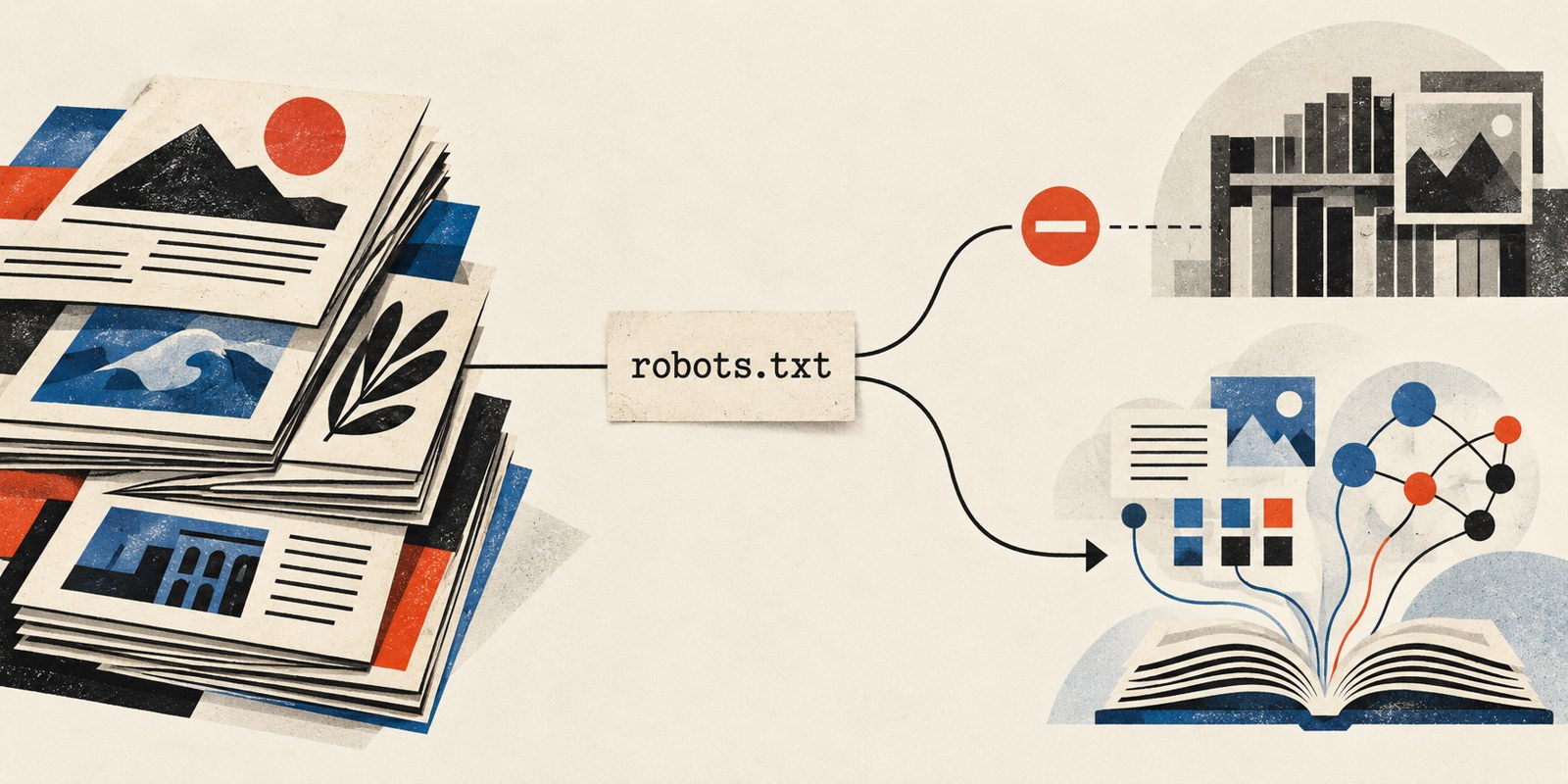 Editorial visualization
A publisher may want its reporting to appear in search without becoming material for training a generative model. Turning that choice into machine-readable instructions has meant keeping track of individual providers. A proposed shared preference would reduce that maintenance work—but its announcement should not be mistaken for a switch that already works everywhere.
OpenAI, Google and Microsoft published their plans on October 30, 2026. Each supports a common training preference in robots.txt, the file websites use to communicate with automated crawlers. The immediate development is agreement on a direction, with implementation still ahead.
One instruction, several deployment calendars
OpenAI says it aims to implement the signal in the coming months and will provide details when it does. Its existing crawler controls remain in place. Website owners therefore have no basis in that announcement to assume a newly published shared instruction already governs OpenAI’s collection.
Google is aiming for support in 2027. It says a shared training opt-out would be treated like a Google-Extended disallow when the publisher has not explicitly specified Google-Extended. Company-specific controls would continue alongside the shared preference. That qualification matters: a broad choice and an explicit provider-specific choice can coexist.
Microsoft gives a more precise start date: February 1, 2027, as it crawls. It also plans page-level training preferences and a separate grounding preference. These choices would not change eligibility for traditional Bing search results, subject to ordinary crawling and indexing requirements.
Training and answering are different uses
Microsoft’s distinction makes the publisher’s decision clearer. Training modifies a model’s learned parameters; grounding supplies content to inform an answer when it is generated. Its proposed controls allow a publisher to refuse the former while permitting the latter. Permission still guarantees neither inclusion nor traffic nor payment.
Google’s announcement describes a different relationship with its existing control: websites that explicitly allow Google-Extended are eligible to appear in responses and receive clicks through grounding in Gemini Apps. A common training signal consequently should not be read as a promise that every provider will offer identical choices about answer generation.
For site owners already using Microsoft’s NoArchive or NoCache preferences, the transition deserves separate attention. Microsoft says those signals will cease to express training or grounding preferences after March 1, 2027. Maintaining grounding restrictions requires both new page preferences and a temporary preference in Bing Webmaster Tools before that date. Publishing instructions alone does not ensure they have been discovered through recrawling.
A proposal, rather than a finished standard
The underlying Internet-Draft, dated October 30 and authored by Anthropic’s Kevin Kelley, describes a policy token in the User-Agent line of an ordinary robots.txt group. It retains the existing path rules and group structure rather than inventing a new file format. That lets the preference refer to particular paths as well as an entire site.
The IETF Datatracker explicitly identifies the document as an individual draft without formal standing in its standards process. Company support is therefore distinct from IETF endorsement. OpenAI also describes its participation as voluntary; the announcements do not establish universal compliance across the web.
For publishers, the useful next step is an inventory of current provider-specific instructions and the choices they are meant to express. The operational test will come with deployment: whether a simpler shared signal preserves those choices across providers whose collection schedules and uses of content still differ.
Publication history
— First published.
No published corrections or earlier versions.
How this was made
UpThat uses AI-assisted research and writing. Source checking and publication follow our editorial review workflow. See the original documents above to assess the reporting.
How we use AI ↗