OpenAI’s Grid Protectors plan builds on Georgia’s 1,000 MW flexibility deal
The November 2 program aims to let future computing campuses reduce grid demand during stressful periods. Its Georgia model is an existing commitment, not a demonstrated power cut.
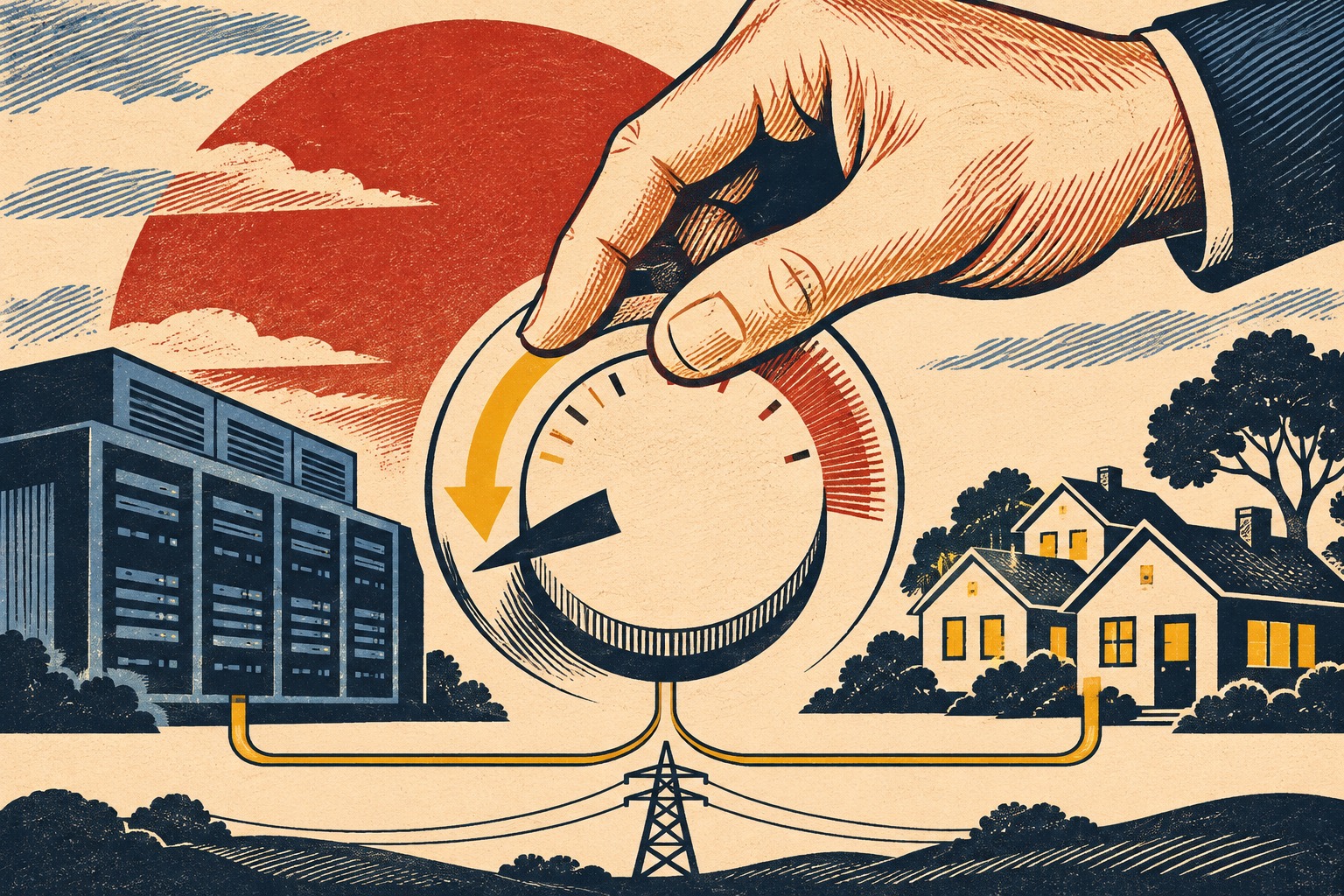 Editorial visualization
OpenAI launched Grid Protectors on November 2 with a proposal for its future computing campuses: reduce their electricity draw when the grid is under strain. Its starting point is a planned Georgia campus whose agreement includes up to 1,000 megawatts of demand response.
That Georgia commitment predates the new program. In its July 22 announcement, Georgia Power said the Effingham County facility was expected to need about 3,200 MW. Under the 25-year agreement, the utility would be able to reduce electricity delivered to the facility at certain times. The 1,000 MW figure describes potential demand reduction, rather than a new power plant supplying that amount.
OpenAI says the campus remains in development and is intended as a pilot. The national program therefore announces an approach to future operations; it does not report a completed 1,000 MW curtailment test.
A data centre can change when or where some computing happens. ASHRAE’s engineering framework describes moving suitable workloads to another region, scheduling them for a less constrained period, or adjusting computing and cooling loads. Storage offers another mechanism: a battery can discharge during a peak, reducing the electricity a facility needs to take from the grid at that moment.
These options have limits. ASHRAE stresses that flexibility is partial and depends on operating conditions, reliability requirements and service agreements. Work cannot simply be deferred or moved whenever electricity is scarce. It also distinguishes changing consumption from exporting power back to the grid; the latter requires suitable equipment and interconnection arrangements.
The cost commitment is a separate part of the Georgia model. Georgia Power said OpenAI would cover the infrastructure and electric-service costs of its facility, with long-term contracts and financial assurances designed to protect other customers. The utility said flexible demand could reduce the new generation it would otherwise need for future growth. That is its expected benefit, not an observed reduction in customer bills.