Google’s Suncatcher returns an AI answer from orbit. Scaling is the next test.
A poem generated aboard a prototype satellite marks an early hardware milestone. Cooling, reliability and connecting multiple spacecraft remain open tests.
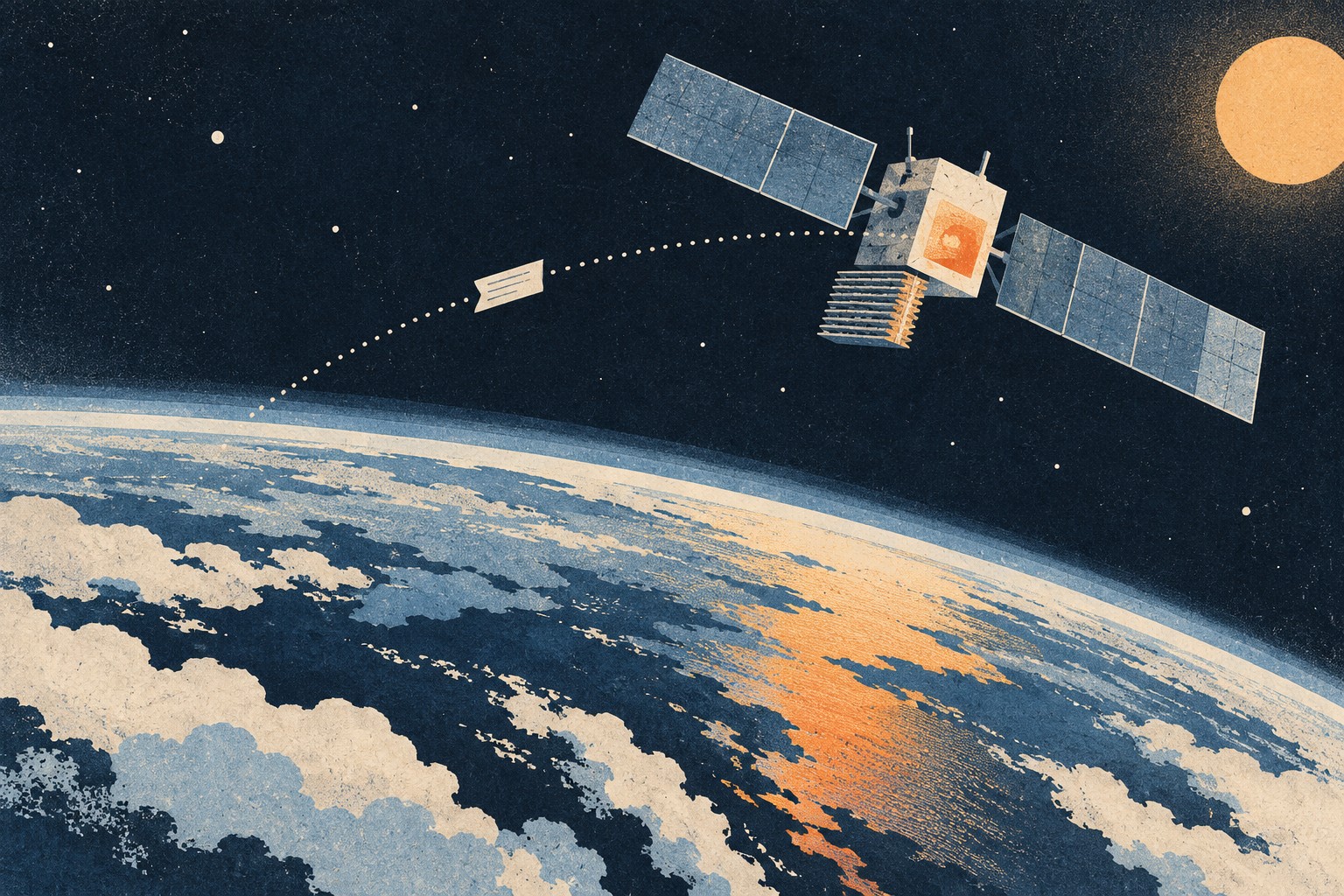 Editorial visualization
Google says its Project Suncatcher prototype has generated an AI response in orbit: a haiku produced by an onboard Gemma 4 model. Announced on October 30, the result leaves the case for an orbital computing network unresolved.
The poem returned during a pass over Svalbard, Norway, after the team uploaded a prompt. Google calls it the first response from a data-center-class TPU in orbit—a specific hardware claim, rather than a claim that AI has never operated in space.
The spacecraft had launched on October 1 aboard SpaceX’s Transporter-18 rideshare mission. Built with Planet, it was designed to collect evidence about how Google’s processors withstand spaceflight and orbital conditions. Google’s launch update confirmed contact with the satellite; the later response announcement adds a reported computation-and-communication result to that earlier deployment milestone.
The distinction matters when reading claims about data centers in space. A successful launch establishes that equipment reached orbit. A returned answer adds evidence that the payload can receive an instruction, run a model and transmit its output. Neither result, by itself, establishes how much dependable computing a larger system could deliver or what it would cost.
The heat still has to go somewhere
In its September engineering explainer, Google identified cooling as a central obstacle. A processor produces concentrated heat, but a vacuum provides no airflow to carry it away. The team has been testing a combination of heat pipes and radiators, including trials in a thermal vacuum chamber.
That makes the cooling system part of the experiment. Google has also described ground-based radiation testing while AI workloads were running, watching for errors such as bit flips. These tests inform the design; they do not substitute for observing how the equipment behaves over time in orbit.
Further orbital tests will examine thermal stress and radiation. The update offers no commercial service date, sustained-throughput benchmark or demonstrated cost advantage. The evidence here is Google’s mission account, rather than an independently audited performance result.
From one payload to a network
Google’s longer-term design calls for clustered satellites connected by high-bandwidth laser links. Its engineering explanation emphasizes precise relative positioning: the links must remain aligned between moving spacecraft. A pair of interconnected satellites is a planned 2027 milestone, not a capability demonstrated by the returned poem.
For readers assessing the next announcement, the useful questions become more demanding: How long can the processors sustain a workload? What errors occur? How effectively does heat leave the payload? And can separate spacecraft exchange data reliably enough to work together? Those measurements would begin to show whether an orbital AI network can progress beyond a successful first message.
Publication history
— First published.
No published corrections or earlier versions.
How this was made
UpThat uses AI-assisted research and writing. Source checking and publication follow our editorial review workflow. See the original documents above to assess the reporting.
How we use AI ↗