A fish school may coordinate one neighbor at a time
A virtual-reality experiment suggests rummy-nose tetras can keep moving together by responding mainly to one influential neighbor, whose identity changes as the group moves.
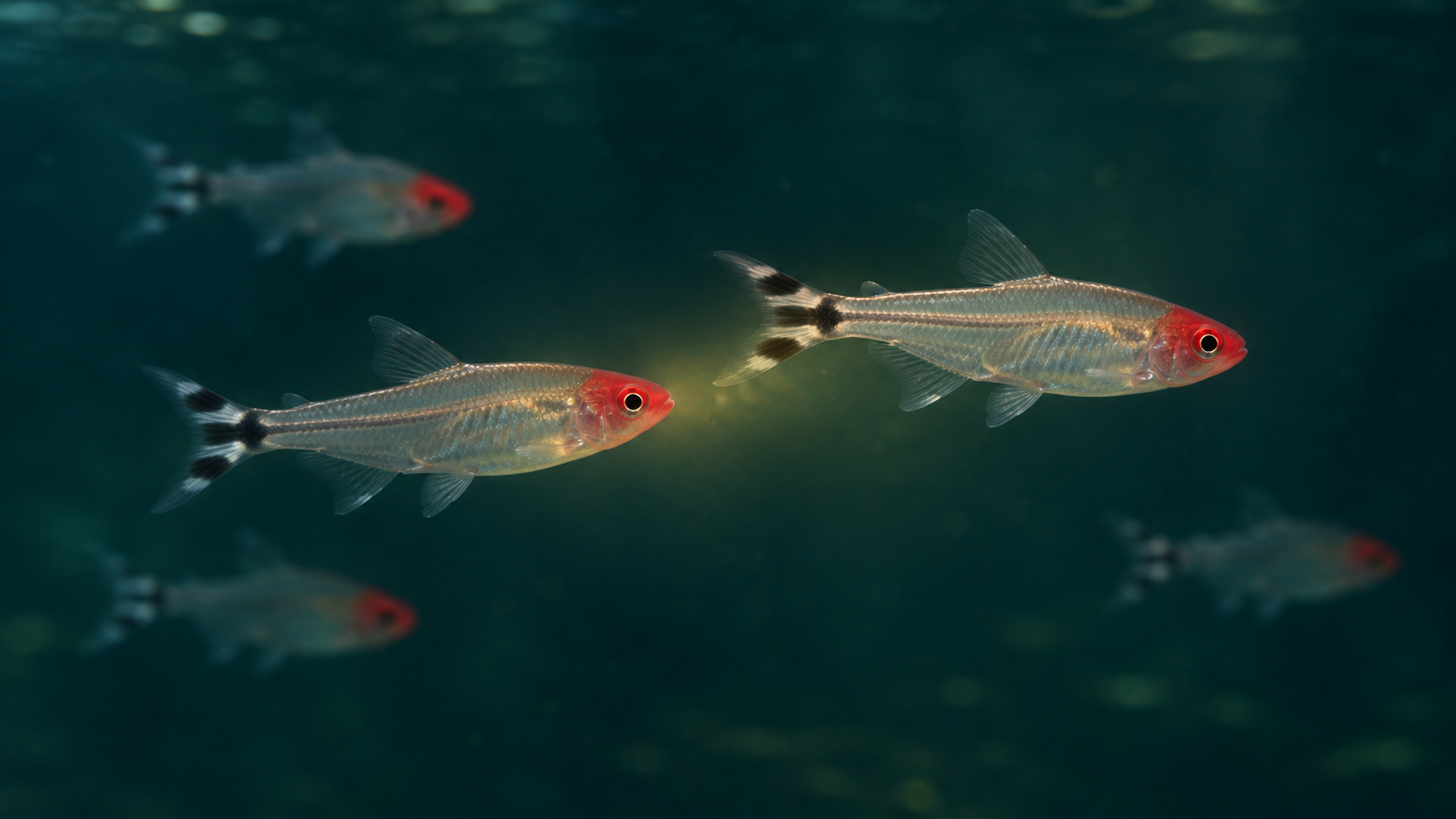 Editorial visualization
A fish can change whom it follows without leaving the school. That is the useful twist in a new experiment: coordinated swimming may depend less on combining everyone’s movements than on selecting one influential neighbor at a time.
In a study published in PRX Life on October 29, Zhen Kang and colleagues put a living rummy-nose tetra among four computer-controlled virtual fish. Comparisons with simulations indicated that the real animal responded mainly to one influential neighbor. As the group rearranged itself, that neighbor could change. The finding concerns this experimental system; it does not establish a rule for every fish school.
Giving one fish a controllable crowd
As APS’s Physics magazine explains, the apparatus used a water-filled bowl about 50 centimeters wide. Its walls acted as an underwater projection screen. A camera above tracked the living fish in three dimensions, allowing the projected neighbors to change position and apparent size as it moved. The animal’s surroundings therefore responded to it, rather than replaying a fixed movie.
The virtual fish were programmed with different social strategies: responding to one influential neighbor, two, or all four. Comparing the living fish’s response with simulations gave researchers a way to distinguish selective following from combining several neighbors’ influence.
That control addresses a basic problem with observing a school: similar trajectories do not necessarily reveal who influenced whom. The original paper reports eight one-hour experiments for each programmed condition, with recording beginning after an acclimatization period. Its conclusion is an inference from movement, spatial organization and turning behavior, rather than a direct measurement of attention inside the fish’s brain.
The modeling has a longer experimental history. In a 2018 PLOS Computational Biology study, Daniel Calovi and colleagues examined rummy-nose tetras swimming alone and in pairs. Their analysis separated attraction—movement that keeps fish together—from alignment, which helps them travel in similar directions. Studying pairs made it possible to characterize a neighbor’s contribution before trying to explain a larger group.
One neighbor does not mean one permanent leader
The latest result is easy to overread as a story about leadership. But an influential neighbor is a changing relationship within the moving group, not an appointed animal at its front. The important distinction is between a fish selecting a social cue and a whole school obeying a single commander.
Related work in another species shows why that distinction deserves attention. UC San Diego reported in August that micro glassfish, Danionella cerebrum, copied the movement direction of a randomly chosen nearby neighbor. Its researchers tested a pairwise copying model with virtual fish, and found that the timing of turns offered opportunities for other animals to align.
That glassfish work is separate research, not a replication of the tetra experiment. Random selection of a nearby neighbor and selection by modeled influence are different proposed rules. Together, the studies make a more precise question possible: which interaction rule fits a particular species and situation, and when does an individual act on it?
There is also a physical limit to the illusion. As the tetra paper acknowledges, projected fish supply visual cues but create no wakes or pressure disturbances. Real neighbors move water as well as appearing in view. The open question is whether the same filtering behavior persists when those missing signals return. A convincing virtual school makes the hypothesis testable; a living school remains the harder test.
Publication history
— First published.
No published corrections or earlier versions.
How this was made
UpThat uses AI-assisted research and writing. Source checking and publication follow our editorial review workflow. See the original documents above to assess the reporting.
How we use AI ↗