AI Support Agents Are Becoming Commodity. Sell the Knowledge and QA Layer Instead
Intercom and Zendesk now sell automated resolutions as a metered product. That shifts the small-business opportunity from building another chatbot to cleaning knowledge, designing escalation rules and continuously testing whether the agent is actually right.
 Editorial visualization
Customer-support AI is no longer a scarce technical capability. In late 2026, major helpdesk vendors increasingly sell autonomous resolution as a metered product: Intercom prices Fin at $0.99 per successful outcome, while Zendesk lists committed automated resolutions at $1.50 and pay-as-you-go resolutions at $2.00. For freelancers and small agencies, that changes where the value sits. Building another generic chatbot is a weak offer; making an existing AI support system reliable is a better one.
The product is becoming a utility
FACT — Intercom’s September 23, 2026 outcome rules charge $0.99 when Fin resolves a conversation, completes a configured procedure handoff, or disqualifies a prospect. A qualified sales lead costs $9.99. The company says unsuccessful attempts are not charged. Its public pricing also lets businesses deploy Fin on an existing helpdesk without buying Intercom seats, subject to minimum commitments.
FACT — Zendesk now includes some automated resolutions in its plans and publishes $1.50 per committed additional resolution or $2.00 pay-as-you-go. Its AI tooling can connect to external systems, expose reasoning controls and support automated quality analysis. The comparison is important: businesses increasingly buy the AI-resolution engine from their helpdesk vendor rather than commissioning a bespoke bot.
That does not make implementation work disappear. It moves the difficult work upstream and downstream of the model: deciding which policy is authoritative, removing contradictory answers, connecting safe actions, defining escalation conditions and continuously testing failures.
What to sell instead of a chatbot
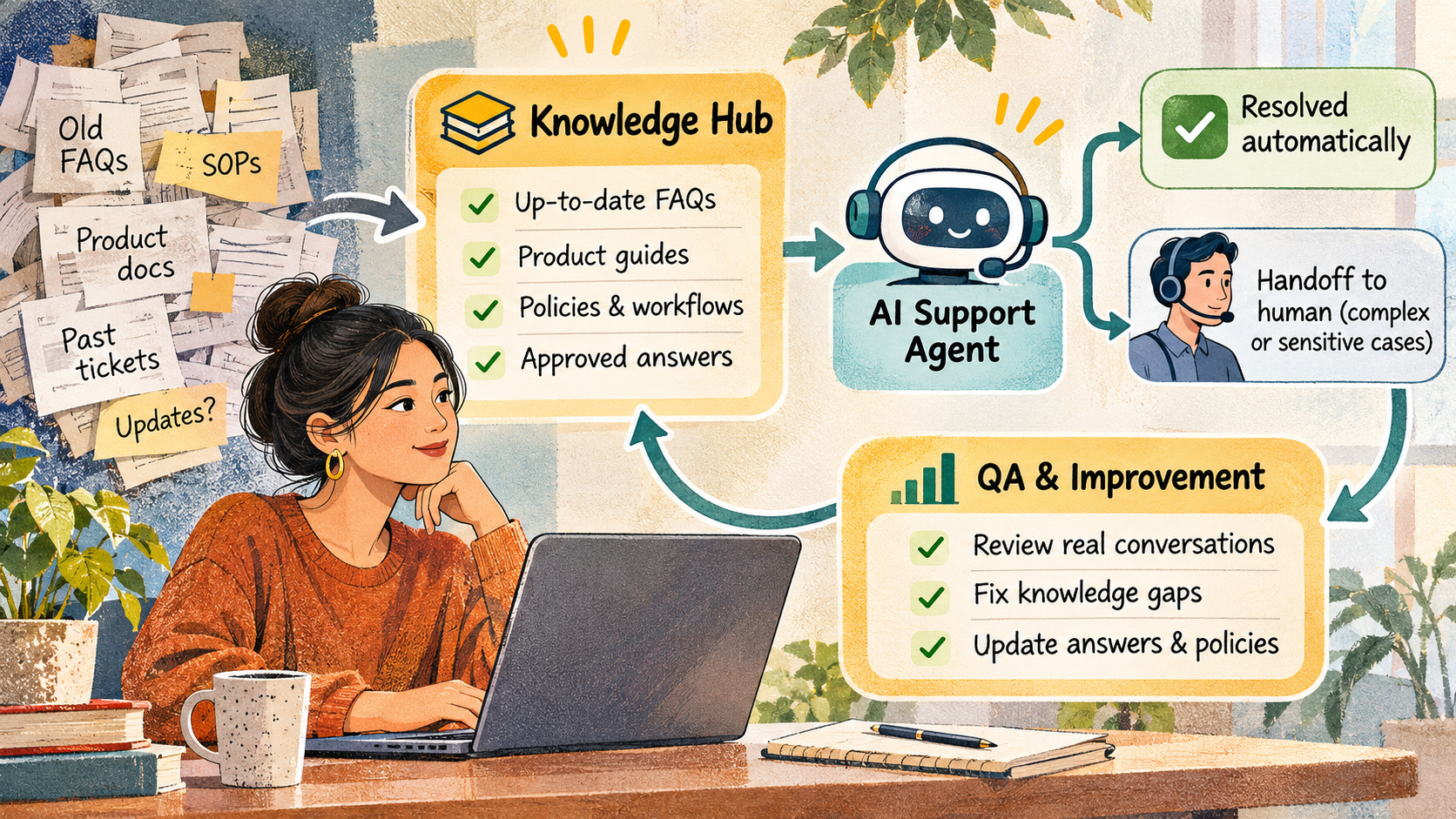
A useful engagement starts with the support operation, not the model. Export 100–500 representative historical conversations. Group them into intents such as order status, returns, account access, product questions, cancellations, complaints and edge cases. Then trace every answer back to its source.
The first deliverable is a canonical knowledge layer. Duplicate help articles are merged. Old return and shipping policies are retired. Every operational rule gets an owner and update date. Answers that depend on region, product, account state or subscription tier are made explicit rather than buried in prose.
Next, define an automation boundary. Low-risk, well-specified requests can be answered automatically. Sensitive account changes, unusual refunds, threats, legal issues, payment disputes and low-confidence cases should move to a human with the conversation history, detected intent and relevant account context attached. The goal is not maximum automation; it is the highest safe resolution rate.
Finally, build an evaluation set from real historical questions. Run it before launch and after every meaningful knowledge or workflow change. Track correct resolution, unsupported claims, unnecessary escalation, missed escalation, handoff quality and customer re-contact. Failed conversations become new tests. This turns support automation into an operating system that can improve rather than a chatbot that quietly drifts.