Why IBM’s new quantum testbed puts a supercomputer next door
The IBM–Oak Ridge–AMD platform pairs quantum processors with Umbra’s CPUs and GPUs. It gives researchers a place to test the fast classical feedback that error correction needs.
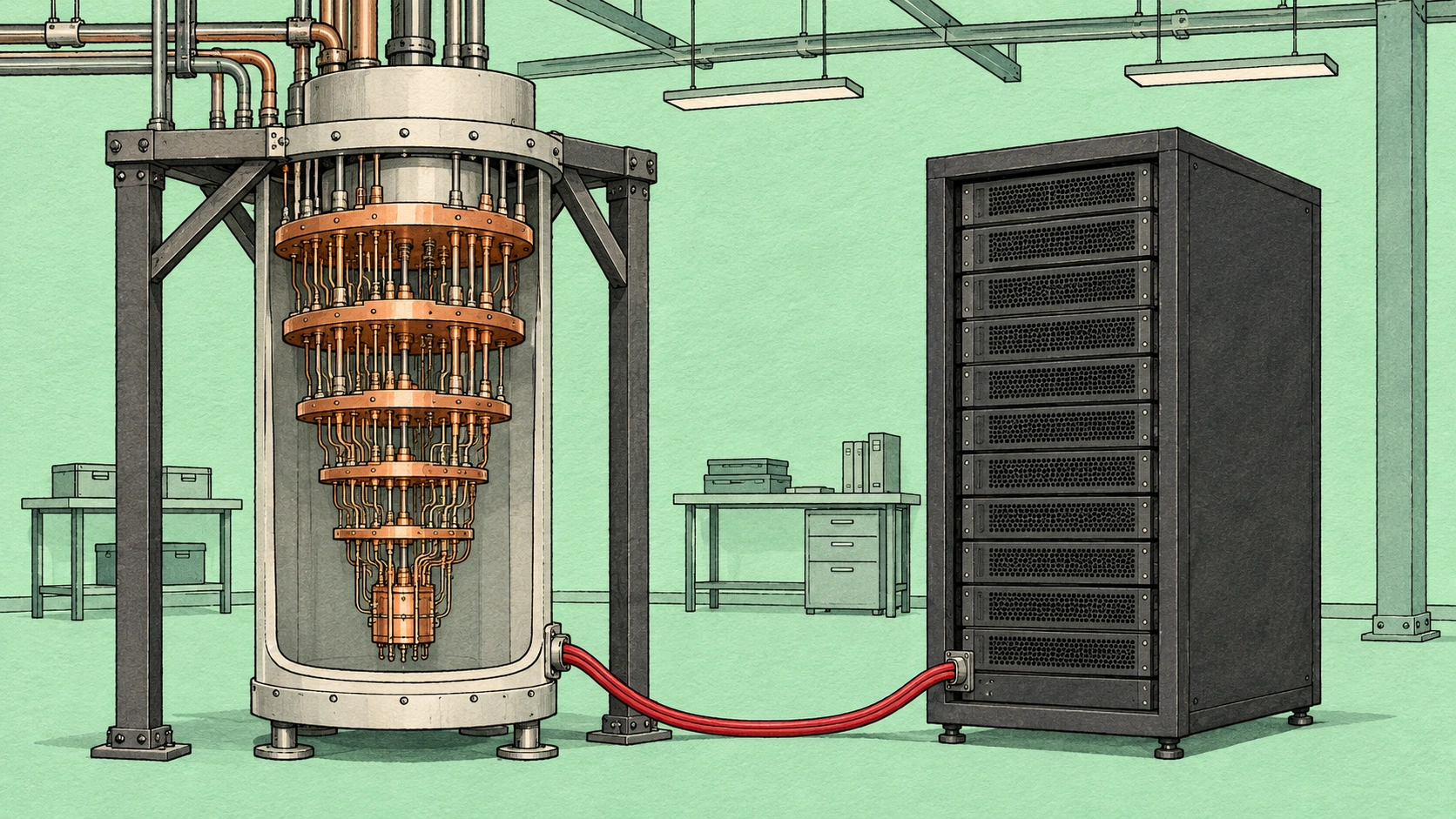 Editorial visualization
A quantum computer’s mistakes must be interpreted by ordinary computers quickly enough to keep the calculation moving. That is the engineering problem behind the platform IBM, Oak Ridge and AMD announced on November 5: IBM quantum hardware and Oak Ridge’s Umbra high-performance computing system now sit together at IBM’s Poughkeepsie site in New York.
The concrete result is a shared research environment for testing error correction and hybrid workflows. The announcement does not establish that the partners have delivered a general-purpose, fault-tolerant quantum computer. It puts the systems needed to investigate that problem close enough to work together.
In reporting published November 6, The Next Platform interviewed IBM architect Seetharami Seelam about the integration. His explanation emphasized that researchers need quantum and classical processors to work closely together to experiment with algorithms. That provides context for the deployment, not an independent performance benchmark.
The decoder has to keep up
IBM’s technical explanation describes error-correcting codes that distribute information across multiple physical qubits and repeatedly check for signs of errors. Classical software called a decoder interprets the check results to infer which errors occurred. This is computing done around the quantum processor, not work the quantum processor handles alone.
A protected unit of encoded information is a logical qubit. IBM’s educational repetition-code example uses three data qubits and two additional measurement qubits to protect against a single bit-flip error. The tutorial explicitly says this is not a complete quantum error-correction code. It illustrates why a physical-qubit count alone says little about a machine’s usable protected computation.
 Editorial visualization
The IBM blog says researchers often reach quantum hardware through cloud access while running classical work on separate systems connected by APIs. Those handoffs add delay and integration work. Colocation is intended to shorten the feedback path, especially when a measurement taken during a calculation determines the next operation.
Different hardware, different jobs
AMD’s account of the deployment describes distinct requirements: orchestration, parallel scientific computation and tightly timed control. The first installation pairs IBM quantum computers, including the 120-qubit Nighthawk, with Umbra’s AMD Instinct MI355X GPUs and fifth-generation EPYC CPUs.
| Component | Role in the research environment |
|---|---|
| IBM Quantum Nighthawk processors | Quantum circuits and measurements used to test error-correction approaches. |
| Umbra: AMD Instinct MI355X GPUs | Classical acceleration for decoder research and parallel computation. |
| Umbra: fifth-generation AMD EPYC CPUs | General-purpose computation and coordination of hybrid work. |
IBM’s release says researchers can measure qubits during a calculation, act on results in real time, control signal timing and examine raw measurement signals. Those capabilities let teams compare what an error-correction method requires in qubits, elapsed time and classical resources.
This is why co-design matters. A code that protects information well may still demand too much decoding work or an impractical response time. The useful comparison is the complete workflow under stated conditions, rather than the speed of one chip in isolation.
 Editorial visualization
A testbed is a step toward the goal
The broader policy goal predates this launch. In September, the Department of Energy announced its Quantum Genesis Q Competition to support scientifically relevant fault-tolerant machines, with proposals seeking systems containing at least 100 logical qubits. That is a target for protected computation, not the same quantity as Nighthawk’s 120 physical qubits.
AMD describes a future connection to the Oak Ridge Leadership Computing Facility. That extension is planned work. It should be distinguished from the quantum and Umbra hardware already placed together in Poughkeepsie.
The cited launch material does not provide an end-to-end latency benchmark or a demonstrated reduction in logical errors for the newly integrated platform. UpThat has not tested it. Measured decoder response times, failure rates and classical resource costs would show whether a particular method remains practical as the quantum workload grows.
For researchers, the immediate benefit is a place to run that comparison without assembling the entire infrastructure first. The next consequential result will be what survives those tests: an error-correction workflow that protects information while keeping its classical helper fast enough to remain useful.
Publication history
— First published.
No published corrections or earlier versions.
How this was made
UpThat uses AI-assisted research and writing. Source checking and publication follow our editorial review workflow. See the original documents above to assess the reporting.
How we use AI ↗