AWS Web Answer packages search and synthesis into one agent tool
The new AgentCore connector returns a sourced answer instead of ranked links. Its price and source controls are clear; accuracy still needs task-specific testing.
 Editorial visualization
AWS made Web Answer generally available on November 5, giving AI agents a managed way to ask a question and receive an answer with source citations. The launch is in US East (N. Virginia). It extends AgentCore’s existing Web Search capability from returning material to producing a synthesized response. AWS’s launch announcement sets out the change.
The service sits behind an AgentCore Gateway, which authenticates the caller and invokes Web Answer through its service role. Web Answer plans searches, reads relevant pages and can search again when evidence is insufficient, according to AWS. The agent receives an MCP tool result containing the answer and citations. The developer walkthrough describes this request flow.

Who owns the synthesis is the practical difference
With Web Search, developers receive ranked results and let their own model decide what to do with them. With Web Answer, AWS operates the retrieval loop and answer-writing model. That shifts a maintenance task out of the application, while giving the developer less control over how this particular answer is assembled. AWS compares the two approaches.
| Tool | What the agent receives | Who synthesizes |
|---|---|---|
| Web Search | Ranked URLs, titles, snippets and metadata | Your application’s model |
| Web Answer | A finished answer with citations | AWS’s managed service |
For example, a support agent might need one current fact from a manufacturer’s public policy page before drafting a reply. Delegating that factual sub-question could simplify the application. A research tool that needs to compare every retrieved passage may have a stronger reason to retain the raw results. These are deployment choices, not performance results demonstrated by this announcement.
Source restrictions depend on the connector version
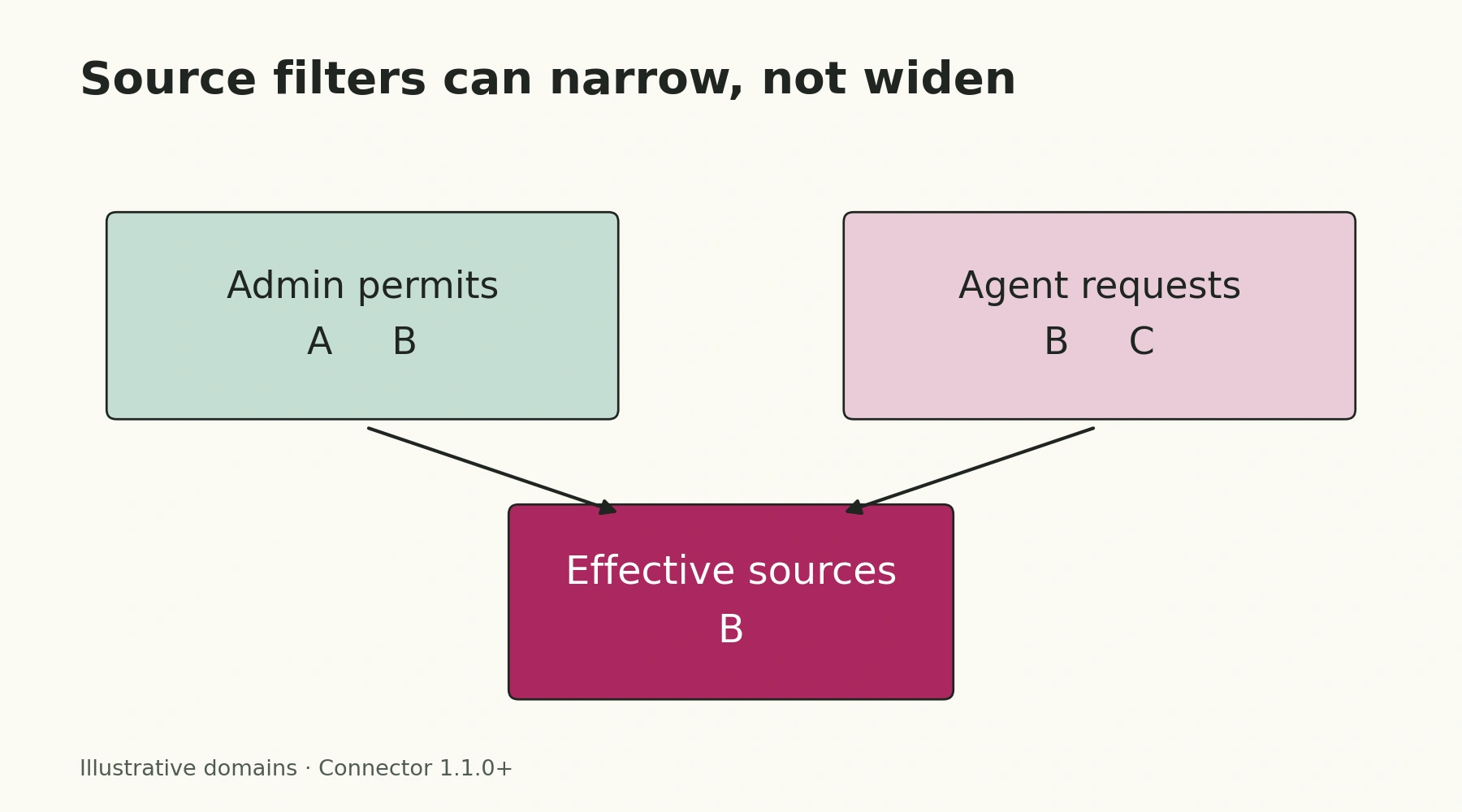
The documentation makes an important distinction: connector version 1.0.0 exposes only the query, while version 1.1.0 and later adds request-level filters and country information. Administrator-level domain restrictions remain binding; a request can narrow the allowed sources but cannot expand them. Read the documented version and filtering rules.
The response includes answer text and structured citation URLs. AWS’s documented acceptable-use requirements say those citations and links must be retained and displayed when results are surfaced to end users. A product that strips the sources loses the very audit trail the tool is designed to provide. The output and citation requirements are documented here.
AWS also says questions are processed within its infrastructure using an Amazon-operated index, without sending them to third-party search engines. The documentation specifies geographic cross-Region inference, so a US East endpoint should not be read as a promise that all processing happens in one Region. AWS describes the data path and regional processing.
The advertised tool fee is only one part of the bill
Web Answer’s listed price is $10 per 1,000 tool calls, rather than per token. AWS lists English as the launch language. The tool’s cost can therefore be estimated from call volume, but a longer agent workflow can make several calls for one user request. See AWS’s product page for pricing and launch scope.
| Tool calls | Web Answer fee |
|---|---|
| 1,000 | $10 |
| 10,000 | $100 |
| 100,000 | $1,000 |
Gateway invocations are also billable, and the surrounding agent still uses its own model. The walkthrough explicitly warns that its setup incurs charges. The figures above calculate only the Web Answer component; they do not establish savings against a custom retrieval system. AWS explains the billable setup.
Citations make checking possible; they do not by themselves show that a source supports every sentence or that conflicting evidence was handled well. UpThat reviewed the launch materials and documentation, not a live accuracy benchmark. Before adopting the connector, teams still need representative questions, source-support checks and a measured cost per successful answer. The useful comparison is the work reliably completed, including review and retries.
Publication history
— First published.
No published corrections or earlier versions.
How this was made
UpThat uses AI-assisted research and writing. Source checking and publication follow our editorial review workflow. See the original documents above to assess the reporting.
How we use AI ↗